
Meet Dominic Evans
• IANTD Cave Diving Instructor
• Technical Diving Instructor
• Cenote Guide 10+ Years
Over a decade of exploring and teaching in the cenotes of Mexico’s Yucatán Peninsula.
A calm, safety-first approach to cave diving, technical training, and unforgettable underwater adventures.
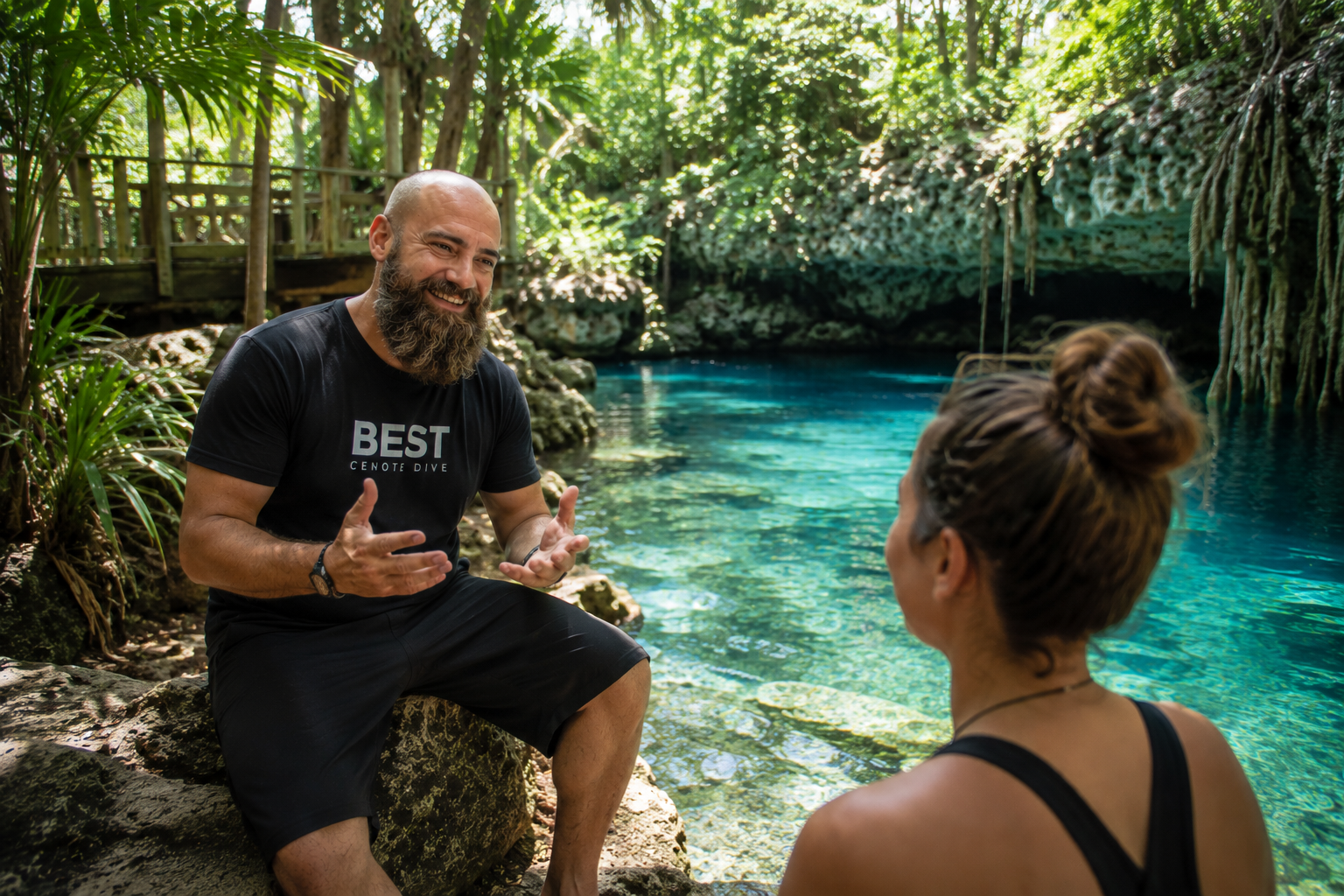
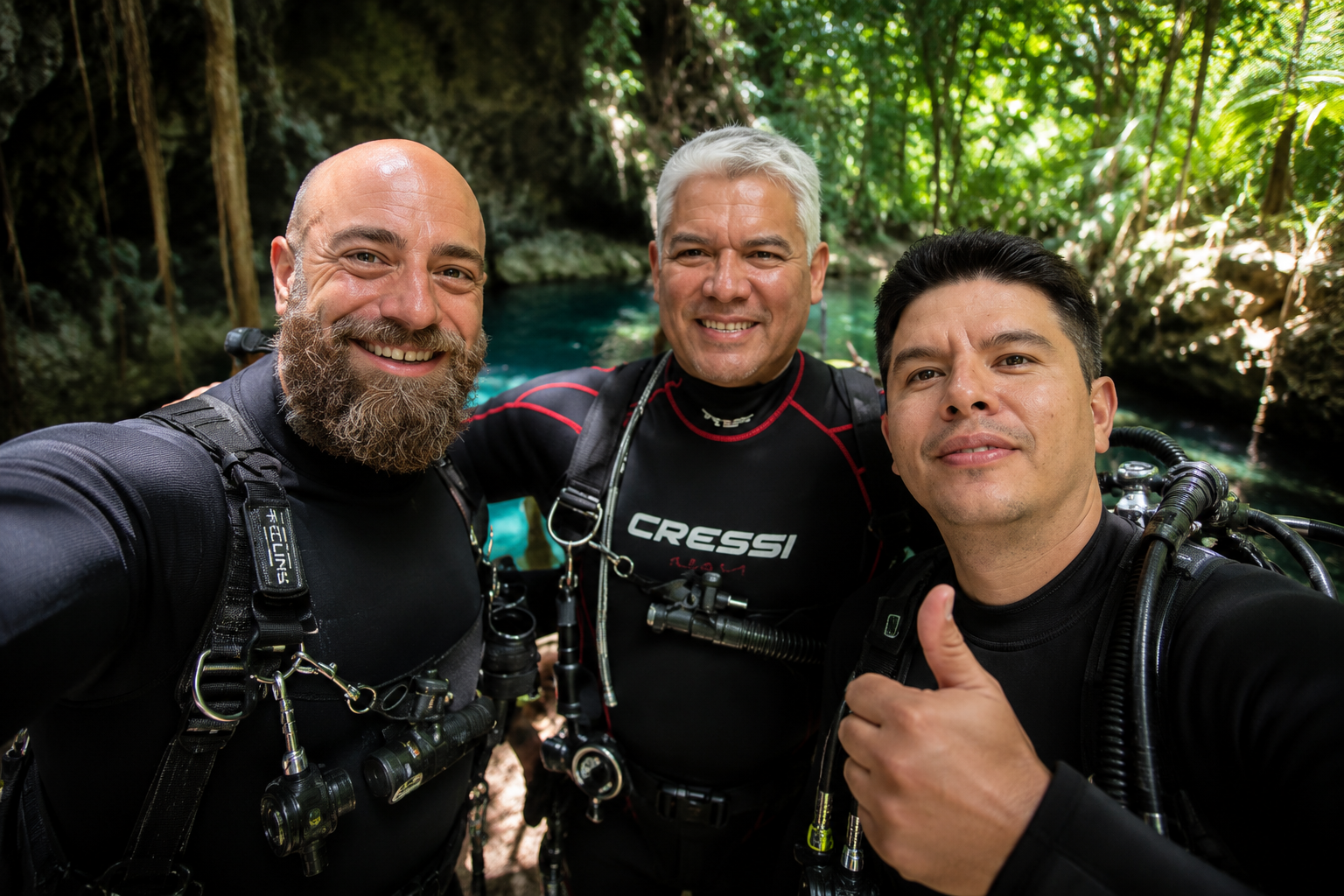
Meet Dominic Evans
Cave & Technical Diving Instructor | Sidemount Instructor | Cenote Guide | Founder of Best Cenote Dives
I’m Dominic Evans, founder of Best Cenote Dives, a cave and technical diving instructor and cenote guide based in Tulum, Mexico.
I’ve spent around 15 years working in the diving industry, with diving taking me from Egypt and Australia to Thailand, Cambodia, Belize and eventually the extraordinary cenotes and underwater cave systems of Mexico’s Yucatán Peninsula.
Today I specialise in private cenote diving, cave diving, sidemount and technical diving instruction.
Best Cenote Dives has deliberately remained a small, personal operation. When you book with me, you dive with me. I’m not trying to build the biggest dive centre in Tulum or put as many divers as possible into a group.
My philosophy is much simpler:
Safe diver. Happy diver.
From Windsurfing to Scuba Diving
I’ve always loved being in the water.
I started windsurfing when I was nine, but strangely enough I came to scuba diving relatively late.
For years, there was one thing that had always put me off. Whenever I swam to the bottom of the deep end of a swimming pool, my ears hurt. I had no idea what equalising was and simply assumed that going underwater at depth hurt my ears.
Then one day I happened to mention this to a friend in a pub.
He explained equalising to me.
I went back to the swimming pool, swam to the bottom, equalised my ears and suddenly realised there wasn’t actually anything preventing me from learning to dive.
That seemingly insignificant conversation ended up changing the direction of my life.
I completed the confined-water part of my Open Water course in the UK and travelled to Egypt to complete my open-water dives. I continued with my Advanced course there and absolutely fell in love with diving.
Falling in Love With Diving
At the time, I was living and working in the UK, so diving had to fit around a conventional career and a limited amount of annual leave.
Egypt became my diving fix.
I particularly loved liveaboards. Rather than doing a couple of dives and going home, I could spend a week or two living on a boat and diving three or four times a day.
Twenty-five or thirty dives during a trip meant I wasn’t simply visiting beautiful dive sites. I could actually feel my diving improving.
For several years, that became the pattern: work in Britain, save some money and then disappear somewhere to dive.
Then one year, weddings and stag parties consumed my holidays and I missed my diving trip altogether.
By the end of the year I realised how much I missed being underwater.
So at the beginning of the following year, I took a month away from work and travelled to Australia to dive the Great Barrier Reef.
That trip changed things again.
Leaving the Rat Race to Become a Diving Instructor
Until then, diving had always been the thing I escaped from work to do.
In 2011, I decided to turn that around.
After returning to Britain, I packed my bags and travelled to Thailand to become a Divemaster and then a diving instructor.
I ended up living in Thailand for around two and a half years, working as an instructor while continuing my own diving education.
I progressed into technical diving, sidemount and cave diving, and later became a technical diving instructor.
Diving subsequently took me through Southeast Asia and the Caribbean, including periods managing dive resorts in Cambodia and Belize.
Eventually, that journey brought me to Mexico.
And Mexico’s cenotes changed everything again.
Discovering the Cenotes and Caves of Mexico
The Yucatán Peninsula offers a kind of diving that is difficult to compare with anywhere else in the world.
Beneath the jungle is an enormous network of flooded caves, passages and chambers.
For recreational divers, the cenotes provide spectacular cavern dives with incredibly clear freshwater, ancient rock formations, haloclines and shafts of sunlight penetrating through openings in the jungle above.
For trained cave divers, they provide access to some of the world’s great underwater cave systems.
After arriving in Mexico, I initially worked for a conventional dive shop in Tulum. I later bought my own vehicle and began working independently, guiding and teaching for different dive operations.
Eventually, I realised that the way cenote diving works in this part of Mexico allowed me to create exactly the kind of diving operation I wanted.
I didn’t need a huge shop, a fleet of boats or a large staff.
I could keep things simple, work directly with the diver and concentrate on the part of the business I actually love:
going diving.
That’s what became Best Cenote Dives.
Why Best Cenote Dives Is Deliberately Small
I’ve never wanted Best Cenote Dives to become the biggest dive operation in Tulum.
I enjoy diving. I enjoy teaching. And I enjoy meeting people who have travelled to Mexico because they want to experience this remarkable underwater environment.
As dive businesses grow, the person who originally loved taking people diving can eventually spend most of their time managing staff and running a business instead.
That’s not the life I wanted to create.
When you contact Best Cenote Dives, you’re talking directly to the person who will be planning your diving and taking you underwater.
That means I can listen to what you actually want rather than simply fitting you into a predetermined itinerary.
It also allows me to keep my cenote diving private or in very small groups.
Why I Prefer Private and Small-Group Cenote Diving
Every diver is different.
Put several strangers with different abilities into the same group and compromises inevitably have to be made.
A more experienced diver can become frustrated because they’re being held back, while a less experienced diver can feel pressured because they think everybody else is waiting for them.
Neither situation makes for a particularly enjoyable day.
With one or two divers, the dynamic is completely different.
If we need to slow down, we slow down.
If you’re comfortable and capable of progressing, we can progress.
If I think a different cenote would be better suited to your experience, interests or the conditions that day, we can change the plan.
The objective isn’t to get everybody through a predetermined schedule.
It’s to give the divers I’m actually with the best day of diving I can.
My Approach to Teaching Diving
The same philosophy applies even more strongly to my sidemount, technical and cave diving courses.
I don’t believe two students necessarily need exactly the same learning experience.
Some divers need more time developing one particular skill and very little time with another. Some learn visually, some through repetition, while others need to understand the reasoning behind a technique before the physical skill falls into place.
The course should adapt to the diver rather than forcing the diver to fit the course.
I’m particularly interested in why something works, rather than simply whether somebody can repeat a skill because an instructor told them to.
Good diving comes from understanding.
That means understanding buoyancy and trim rather than simply trying to hold a particular position. Understanding why equipment is configured in a particular way. Understanding gas management rather than merely memorising a number.
And particularly in cave diving, it means understanding the principles behind the procedures we use.
Standards and procedures matter enormously in technical and overhead-environment diving. But good instruction should also develop independent thinking.
My job isn’t simply to produce a diver who performs correctly while I’m next to them.
It’s to help develop a diver who understands what they’re doing, can evaluate a situation and can make good decisions when I’m no longer there.
Cave, Technical and Sidemount Diving
Cave diving became a major part of my own development as both a diver and an instructor.
Today, my teaching ranges from recreational and sidemount diving through to technical and advanced cave diving.
Progressing into cave diving isn’t simply about learning how to swim further into a cave.
It requires excellent buoyancy and trim, propulsion techniques, equipment familiarity, line handling, gas management, situational awareness, communication and increasingly sophisticated problem solving.
One of the things I enjoy most about teaching cave diving is watching all of those individual elements gradually come together.
The result isn’t simply a better cave diver.
It’s usually a much better diver.
My Diving Instructor Qualifications
I’m an IANTD Technical Cave Instructor, PADI Staff Instructor and PADI Tec Deep Instructor, with qualifications and teaching experience spanning recreational, sidemount, technical and cave diving.
My IANTD professional qualifications and specialist areas include:
- Technical Cave
- Advanced Cave Stage/Multi-Stage
- Advanced Cave DPV
- Technical Diving
- Technical Sidemount
- Cavern and Introductory Cave
- Sidemount
- Advanced Nitrox and Decompression
- DPV and Technical DPV
This allows me to work with divers across a broad progression, from recreational divers developing their fundamental skills through to experienced technical divers progressing into advanced cave diving.
Honesty Before the Sale
I’ve spent enough time in the diving industry to know that it’s easy to promise somebody exactly what they want to hear.
That’s not how I want to operate.
If I don’t think a particular dive is appropriate for your experience, I’ll tell you.
If another cenote would give you a better experience, I’ll recommend it.
If I think you need more time developing a skill before progressing during a course, we’ll work on that skill.
And if what you’re looking for isn’t something I can genuinely provide, I’d rather tell you before you book.
That may occasionally cost me a booking.
I’m comfortable with that.
I’d rather someone arrive knowing exactly what to expect and finish their diving feeling that the experience exceeded those expectations.
I Still Love Going Diving
Leaving my old career in Britain to become a diving instructor meant walking away from a conventional career and a considerably more predictable way of earning a living.
It was also one of the best decisions I’ve ever made.
Diving has taken me around the world, introduced me to extraordinary people and eventually given me a life in Mexico surrounded by some of the most remarkable diving on the planet.
And after all these years, I still look forward to getting in the water.
That’s probably the simplest explanation for why Best Cenote Dives has remained the way it is.
I didn’t start Best Cenote Dives because I wanted to build a large dive company.
I started it because I love diving.
And if you’ve travelled all the way to Mexico to experience the cenotes, I want you to come out of the water understanding why I love them too.
Come Diving With Me in Tulum
Whether you’re planning your first cenote dives, looking for a private cenote guide, developing your sidemount skills or progressing into cave diving, you’re welcome to contact me directly.
Tell me about your certification, diving experience and what you’d like to do, and I’ll help you work out the dives or training that are right for you.
years in tulum
Cenote & Cave Dives
Students Trained
Cave Systems Explored
Why Divers Choose Best Cenote Dives
Safety First
Every course is built around calm, safe progression.
Personal Instruction
Private and small group courses tailored to you.
Local Knowledge
Thousands of dives across the Yucatán’s finest cenotes.
International Certifications
IANTD and PADI instruction from beginner through full cave.