What is the best dive knife?
It sounds like a simple question, but after years of scuba diving, technical diving and cave diving, I think the better question is:
What is the best cutting device for diving?
A dive knife is not a weapon. It is a safety tool designed primarily to help you or another diver escape from an entanglement.
Fishing line, nets, rope and other debris can all potentially entangle a diver. In cave and technical diving, we also spend a lot of time around guideline, which makes carrying an effective cutting device particularly important.
Personally, I don’t think most scuba divers need a huge James Bond-style knife strapped to their leg. There are much smaller and more practical options available.
For most diving, I prefer compact cutting devices that are sharp, safe and, most importantly, easy to reach.
For technical and cave diving, I recommend carrying at least two independent cutting devices.
Affiliate disclosure: As an Amazon Associate I earn from qualifying purchases. Some links in this article are affiliate links, which means I may earn a commission if you purchase through them, at no extra cost to you.
Table of Contents
My Best Dive Knife & Cutting Tool Recommendations – Quick Comparison
| Cutting Tool | Best For | Cave / Tech Diving | Where to Carry | Why I Like It |
|---|---|---|---|---|
| EEZYCUT Trilobite & Similar Double Line Cutters | Best Overall | Excellent | Shoulder or waist harness | Two protected cutting sides, compact, replaceable blades and easy access |
| Dive Rite Ceramic Line Cutter | Best Alternative Line Cutter | Excellent | Harness / webbing | Small, streamlined and corrosion-resistant ceramic blade |
| Scubapro X-Cut TEK Knife | Best Compact Technical Knife | Excellent | Waist harness | Compact proper knife with line-cutting notches; stays close to the body |
| Aqualung Micro Squeeze Blunt Tip | Best Compact Blunt-Tip Knife | Very Good | BCD / harness | Small, streamlined conventional knife with blunt tip and line cutter |
| Aqualung Small Squeeze Blunt Tip | Best Recreational Dive Knife | Good | BCD / harness | Traditional versatile dive knife without the bulk of a large leg knife |
| Scuba Choice Folding Dive Knife | Best Backup Knife | Good as backup | Pouch / pocket | Folds safely away and gives you a more substantial blade when needed |
| Dive / Trauma Shears | Best Heavy-Duty Cutter | Excellent backup | Pouch / pocket | Better suited to thicker fishing net, line and other marine debris |
| Large Traditional Dive Knife | Spearfishing / Recreational Use | Not recommended for cave diving | Leg / calf | Large blade, but bulky mounting can introduce additional snag and entanglement points |
My Pick: EEZYCUT Trilobite
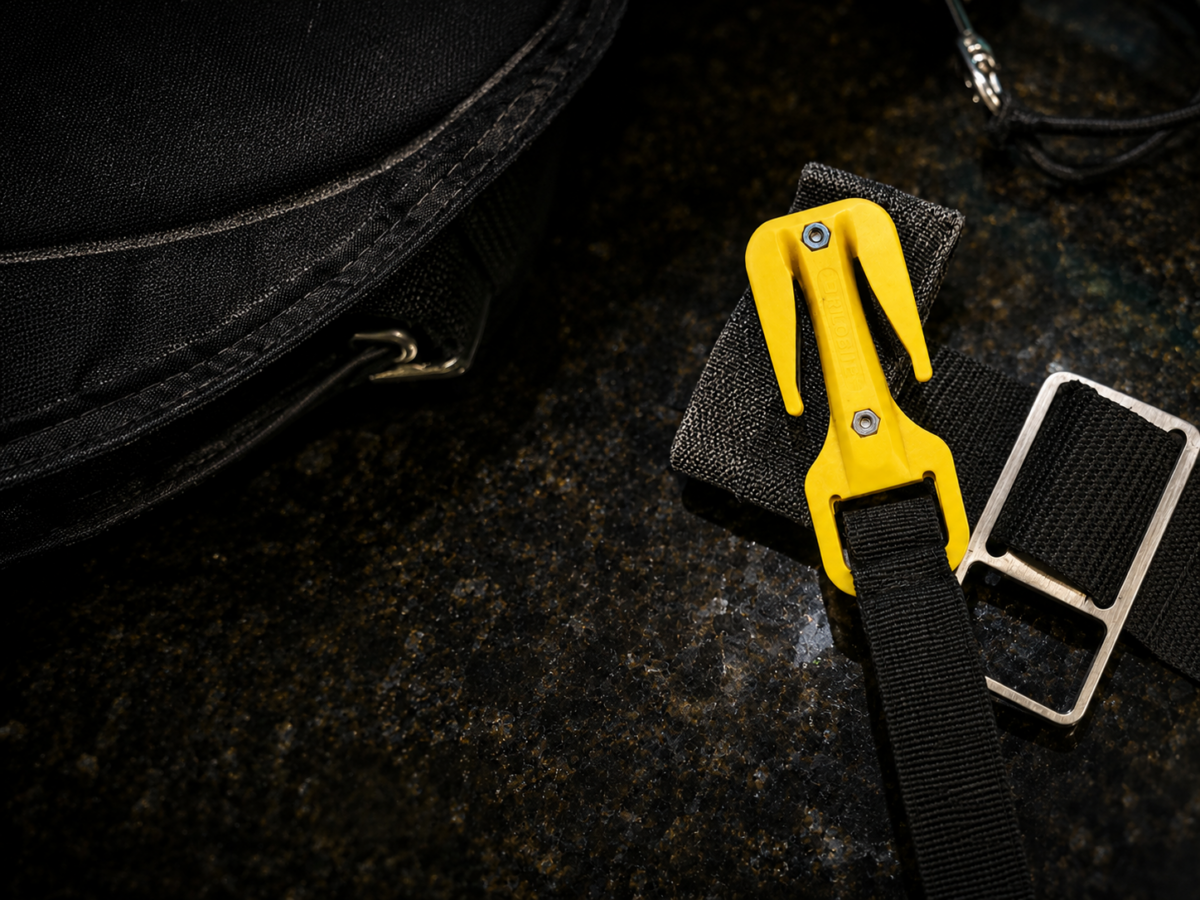
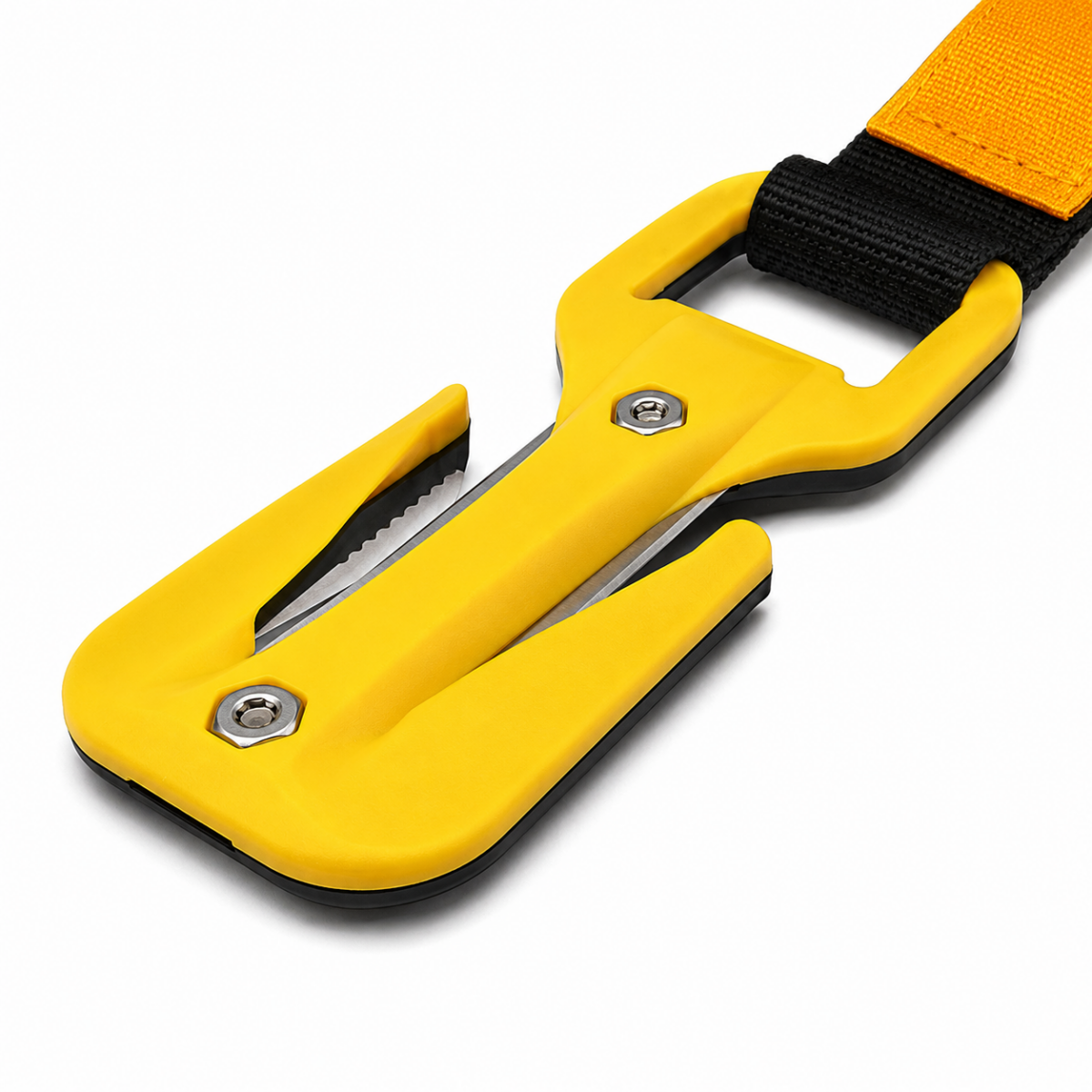
For the type of diving I do, the EEZYCUT Trilobite is my first choice. It is small, streamlined and can be mounted on a harness where I can reach it quickly. It has two cutting sides, so there is some redundancy within the cutter itself, and the blades are easy to replace if they become blunt or corroded.
Most importantly for cave and technical diving, it does its job without introducing a large knife, leg straps or unnecessary equipment that could themselves create another entanglement hazard.
I would still carry a second independent cutting device.
If you’re looking for the cutting tools I use and recommend, you can check the Trilobite directly or see my full list of recommended dive knives and cutting tools below.
What Is a Dive Knife Used For?
The primary purpose of a dive knife is to cut a diver free from an entanglement.
Underwater you could potentially become caught in:
- Fishing line
- Fishing nets
- Rope
- Cord
- Dive equipment
- Cave or wreck guideline
- Other underwater debris
In an emergency, you may need to cut whatever has trapped you. In a more serious situation, you might even have to cut part of your own equipment to free yourself.
This is why accessibility is more important than having the biggest or most impressive-looking knife.
If your right hand is trapped, can you reach your cutting device with your left hand?
If the answer is no, you may be carrying it in the wrong place.
A cutting device that you cannot reach when you need it isn’t much use.
Should Scuba Divers Carry a Dive Knife?
I believe every scuba diver should carry at least one effective cutting device.
That doesn’t necessarily mean a traditional knife.
There are three main options:
Dive knives
Line cutters
Diving shears or trauma shears
Each has advantages and disadvantages.
For recreational scuba diving, one good cutting device may be sufficient. For cave and technical diving, where redundancy is an important part of equipment configuration, I carry more than one.
Dive Knife vs Line Cutter vs Shears – Which Is Best?
There isn’t one cutting device that is perfect for every situation.
Dive Knife
The traditional scuba diving knife has been around for decades.
Think of the classic image of a diver with a huge knife strapped to their calf. James Bond certainly helped make that look famous.
But we’re not carrying knives underwater to fight villains or sharks.
A modern dive knife is a tool.
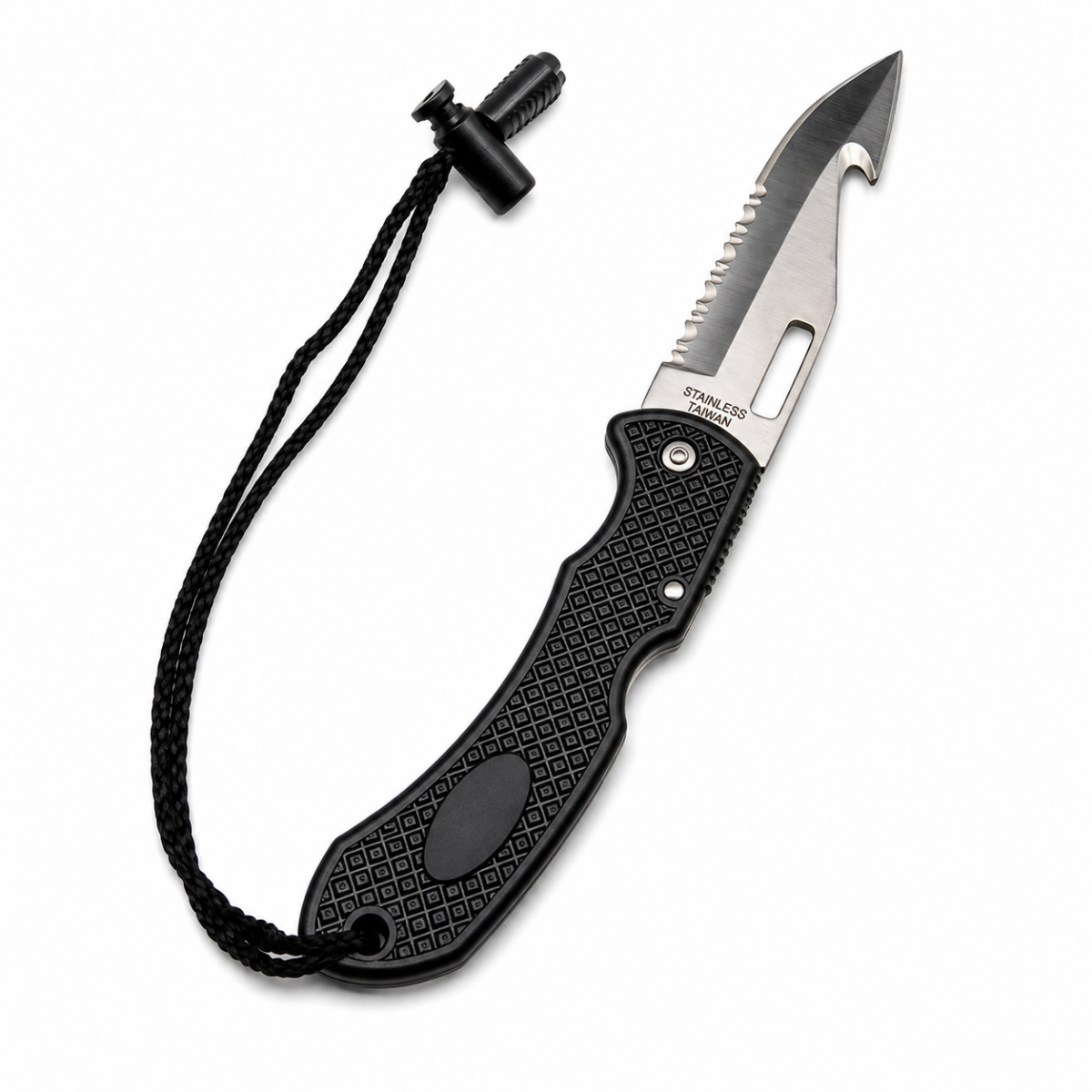
Dive knives are versatile and can cut different materials. Many have both straight and serrated sections, and some incorporate a line-cutting hook.
However, a large knife can be unnecessarily bulky for normal scuba diving.
Personally, I prefer smaller cutting devices.
Line Cutter
A line cutter is one of my favourite cutting tools for diving.
Instead of having a large exposed blade, the cutting blade is recessed inside the device.
You slide the line or material into the cutting slot and pull the cutter through it.
This design has several advantages.
Line cutters are:
- Small
- Lightweight
- Extremely easy to carry
- Difficult to accidentally cut yourself with
- Less likely to damage your equipment
- Very effective against line and webbing
They can also be mounted in locations where they’re easy to reach.
For cave and technical diving, this makes a compact line cutter an extremely useful piece of equipment.
Diving Shears
Don’t overlook a decent pair of shears.
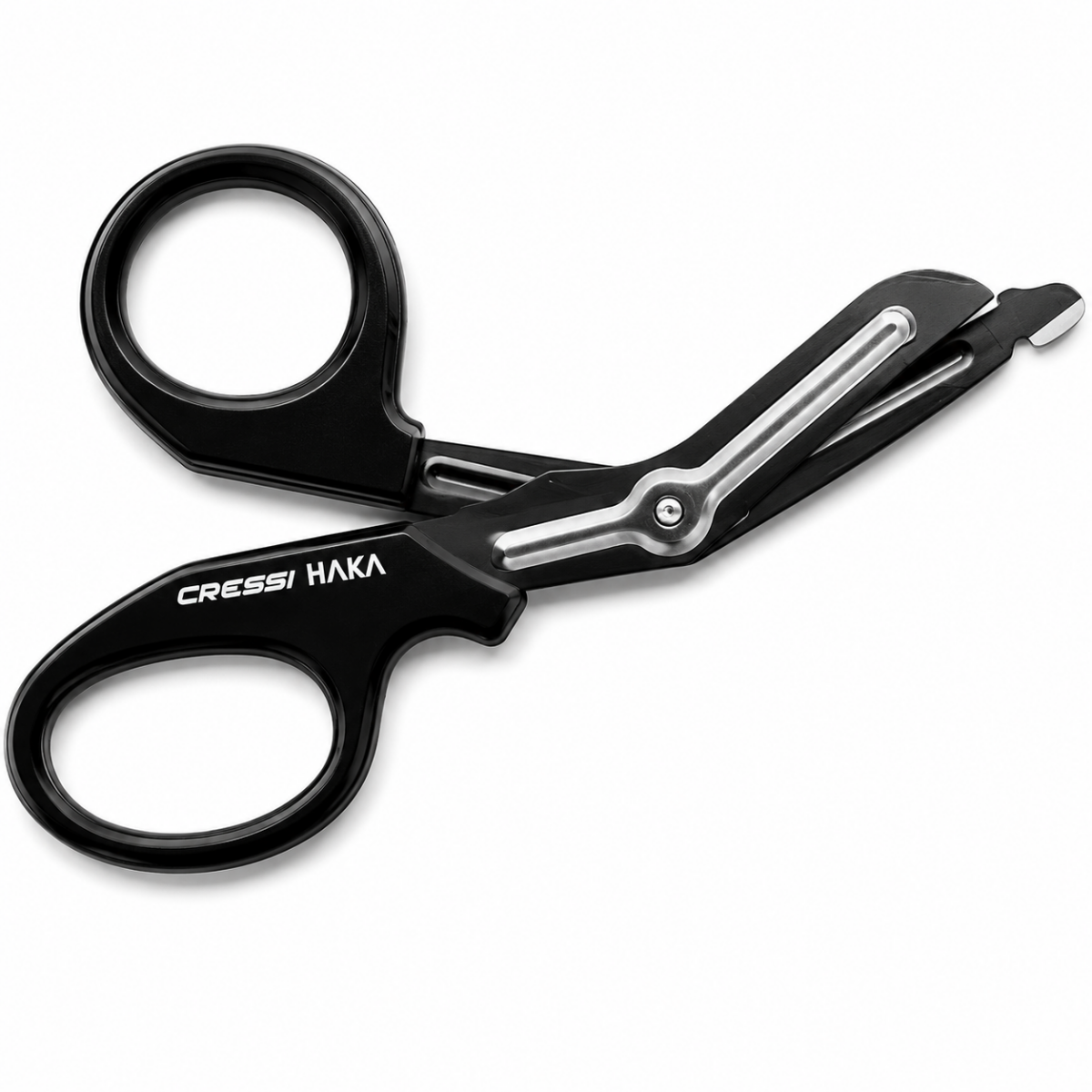
Trauma shears aren’t particularly glamorous, but they work.
The scissor action gives you mechanical leverage, which can make shears particularly effective when cutting thicker or tougher material.
The enclosed shape of the blades also reduces the chance of accidentally stabbing yourself or damaging your equipment.
Their main disadvantage is their size.
They’re bulkier than a compact line cutter, so I normally prefer to carry shears in a pocket rather than strapped somewhere externally.
Recommended Dive Knives & Cutting Tools
If you’re choosing a cutting tool, I generally prefer a compact line cutter as the primary option, with a second independent cutting device as backup. Below are some of the dive knives, line cutters and shears I recommend or would consider.
What Should You Look for in a Good Dive Knife?
For me, there are three particularly important characteristics.
Small. Safe. Sharp.
Small
I don’t want a huge knife hanging off my equipment.
A compact cutting device can be mounted somewhere accessible without creating unnecessary bulk or another potential entanglement point.
Safe
You’re potentially going to use this tool while stressed, entangled and underwater.
The last thing you need is to accidentally puncture your BCD, wing, drysuit, hose—or yourself.
That’s one reason I like enclosed line cutters and blunt-tip knives.
Sharp
When I actually need my cutting device, I want it to work.
An emergency isn’t the time to discover that the blade has corroded or become blunt.
Whatever cutting device you carry, inspect it periodically and replace or sharpen the blade when necessary.
What Is the Best Material for a Dive Knife?
Two of the most common materials are stainless steel and titanium.
Both can make excellent dive knives, but they have different advantages.
Stainless Steel Dive Knives
Stainless steel knives are widely available and usually less expensive than titanium knives.
Good stainless steel can hold an effective cutting edge, but despite the name, stainless steel isn’t completely immune to corrosion.
Saltwater is particularly hard on diving equipment.
A stainless-steel knife should therefore be rinsed properly with fresh water after diving and periodically inspected for corrosion.
Titanium Dive Knives
Titanium’s big advantage for diving is its excellent resistance to corrosion.
It’s also lightweight, which makes it attractive for scuba equipment.
The disadvantage is price. Titanium dive knives generally cost more than comparable stainless-steel models.
So is titanium worth it?
It can be, particularly if you’re regularly diving in saltwater and want something lightweight and highly corrosion resistant.
But don’t assume a knife is automatically better simply because it says titanium on the box.
Blade design, accessibility, construction and how well the knife actually cuts the materials you’re concerned about are more important.
Blunt Tip or Pointed Dive Knife?
For normal scuba diving, I generally prefer a blunt-tip dive knife.
Remember what we’re trying to accomplish.
We’re trying to cut ourselves or another diver free—not stab something.
A pointed knife introduces another sharp point close to:
- BCDs and wings
- Hoses
- Exposure suits
- Sidemount bladders
- Dry suits
- Other divers
- Your own body
A blunt tip reduces the chance of accidentally puncturing something.
Some blunt-tip knives can also be used for simple tasks such as light prying or as an emergency screwdriver, depending on their design.
There are situations, particularly spearfishing, where divers may deliberately choose a pointed knife. But that’s a different requirement from the safety cutting device I want for recreational, technical or cave diving.
What Is the Best Dive Knife for Cave Diving?
This is where my priorities change considerably.
When cave diving, I’m not interested in carrying an enormous knife strapped to my leg.
I want small, streamlined and accessible cutting devices with redundancy.
Cave divers operate around permanent guidelines and may also deploy reels, spools and jump lines during a dive.
That makes line awareness extremely important.
It also means I want to know that if I ever do become entangled, I can reach a cutting device quickly.
I carry more than one cutting device when cave diving so that the loss or failure of one doesn’t leave me without another option.
And placement matters.
I want my primary cutting device somewhere I can reach naturally and quickly, preferably with either hand.
The backup should be independently accessible rather than simply sitting beside the first one.
This is the same principle we use throughout technical and cave diving:
Don’t just carry redundant equipment. Think about whether you could actually access that redundancy during the failure you’re preparing for.
Where Should You Carry a Dive Knife?
There isn’t one correct location for every diver.
Your equipment configuration, exposure protection and type of diving all affect the best position.
The important questions are:
Can you reach it easily?
Can you reach it with either hand?
Will it remain secure during the dive?
Does it create an additional entanglement hazard?
Dive Knife on the Leg
The traditional position is strapped to the lower leg.
It looks very “diver”, but I’m not particularly fond of this position.
A large knife on the calf is relatively far from your hands and adds something else that can potentially catch on line or the environment.
For some divers and types of diving it works perfectly well, but bigger isn’t necessarily better.
Dive Knife on the Waist Belt
A compact knife or line cutter mounted on the waist strap can be easy to reach and keeps the equipment close to the body.
This can work very well with a backplate-and-wing or technical harness.
Just make sure other equipment doesn’t block access to it.
Dive Knife on the BCD or Harness
A compact cutting device can also be mounted on a shoulder strap or another suitable part of the BCD or harness.
Again, test whether you can genuinely reach and deploy it with both hands while wearing all your equipment.
Don’t just try it while standing in your bedroom.
Dive Knife on the Wrist or Forearm
Some compact line cutters can be mounted on a wrist or computer strap.
This makes the cutter extremely accessible.
However, think through what would happen if that particular arm became trapped.
That’s one reason redundancy is important in more advanced diving.
Dive Knife in a Pocket
A pocket is a good place for shears or a backup cutting device.
The equipment stays streamlined and protected.
The disadvantage is accessibility. You need to be able to open the pocket and retrieve the cutter easily, including while wearing gloves if that’s how you dive.
What Is the Best Dive Knife for Recreational Scuba Diving?
For most recreational scuba divers, I wouldn’t automatically recommend a large traditional knife.
I’d look for either:
a compact blunt-tip dive knife, a good line cutter, or a pair of trauma shears.
If your main concern is fishing line, monofilament and similar entanglement hazards, a compact line cutter is difficult to beat.
If you want something capable of dealing with a wider range of materials, shears make an excellent addition.
If you prefer a traditional knife, choose something compact, secure and easily accessible rather than simply buying the biggest knife available.
My Best Dive Knive and Cutting Tool Recommendations
There are hundreds of dive knives available, but these are the types of cutting devices I would concentrate on rather than buying something simply because it looks impressive.
EEZYCUT Trilobite – Best Line Cutter
The EEZYCUT Trilobite has been popular with recreational, technical and cave divers for good reason.
It’s tiny, the cutting blades are protected inside the body of the cutter, and it can be mounted in several convenient positions.
The design guides line and webbing towards the blade while making it difficult to accidentally cut yourself.
For the type of diving I do, this style of cutter makes far more sense than a huge knife strapped to my leg.
Best for: Cave diving, technical diving and general line cutting.
Advantages: Compact, safe, replaceable blades and easy to mount.
Disadvantages: It’s primarily a cutter rather than a multipurpose knife.
Trauma Shears – Best Dive Shears
Sometimes the simplest solution is the best.
A decent pair of trauma shears is inexpensive and remarkably effective.
The scissor action provides leverage and they can deal with materials that may be awkward for a small line cutter.
They’re bulkier, so I prefer carrying them in a pocket.
Best for: Tougher material, webbing and backup cutting.
Advantages: Cheap, powerful and relatively safe.
Disadvantages: Bulkier than a line cutter.
Compact Blunt-Tip Dive Knife – Best Traditional Dive Knife
If you want an actual knife rather than a line cutter, I’d choose a compact blunt-tip model.
You get the versatility of a conventional blade without the unnecessary size and sharp point of the classic large diving knife.
Look for a secure sheath, a handle you can grip with wet or gloved hands, and a mounting system that actually works with your equipment.
Best for: Divers wanting a multipurpose cutting tool.
Advantages: Versatile and capable of cutting different materials.
Disadvantages: More exposed blade than a line cutter.
Titanium Dive Knife – Best for Corrosion Resistance
For divers who spend a lot of time in saltwater, titanium is worth considering.
Its excellent corrosion resistance and low weight make it particularly well suited to diving.
However, I wouldn’t choose a knife purely because it’s titanium.
I’d still prioritise blade design, size, sheath security and accessibility.
Best for: Regular saltwater divers.
Advantages: Excellent corrosion resistance and lightweight.
Disadvantages: Usually more expensive.
Do You Need Two Dive Knives?
For ordinary recreational diving, carrying two cutting devices isn’t always necessary.
For technical and cave diving, I strongly prefer redundancy.
But that doesn’t mean carrying two enormous knives.
A much more sensible configuration might be a compact primary line cutter together with shears or another cutter stored independently as a backup.
The important word is independently.
If both cutting devices are mounted somewhere you cannot reach when one arm is trapped, you’ve duplicated the equipment without really duplicating the capability.
How Do You Maintain a Dive Knife?
Like the rest of your scuba equipment, your cutting devices need looking after.
After diving—particularly in saltwater—rinse them thoroughly in fresh water.
Remove the knife from its sheath occasionally and inspect both.
Look for:
- Corrosion
- A blunt or damaged blade
- Sand or debris
- Damage to the sheath
- Worn straps or mounting hardware
- Problems with the locking or release mechanism
If you use a line cutter with replaceable blades, check the blades regularly.
Don’t wait until an emergency to discover they need changing.
Can You Travel With a Dive Knife?
Be careful when travelling with any dive knife.
A dive knife should never be placed in your hand luggage when flying.
Rules concerning knives vary between airlines, airports and countries, so check the regulations applicable to your journey before travelling.
Even if a knife can legally be transported in checked baggage, local laws at your destination may restrict the possession or carrying of certain knives.
A compact line cutter or pair of shears may sometimes be easier to travel with, but don’t assume they’re automatically permitted either. Check before you fly.
Frequently Asked Questions About Dive Knives
What is a dive knife used for?
A dive knife is primarily a safety and utility tool. Its most important purpose is cutting a diver or their buddy free from fishing line, net, rope or another entanglement.
Should scuba divers carry a knife?
I recommend that scuba divers carry at least one effective cutting device. It doesn’t necessarily have to be a traditional knife. A line cutter or diving shears may be a better option.
What is the best knife for scuba diving?
For most scuba divers, I prefer a compact blunt-tip knife or enclosed line cutter rather than a large pointed knife. The best option depends on the type of diving you do and the materials you may need to cut.
Are dive knives sharp?
They should be. A cutting device isn’t much use if it can’t cut effectively. Check your blade regularly for corrosion, damage and loss of sharpness.
What is the difference between a dive knife and a regular knife?
Dive knives are designed specifically for underwater use. They generally use corrosion-resistant materials and have sheaths and mounting systems designed for scuba equipment. Many also incorporate serrated edges or line-cutting hooks.
Is titanium or stainless steel better for a dive knife?
Neither is automatically better. Titanium is lightweight and exceptionally corrosion resistant but usually more expensive. Stainless steel is affordable and can make an excellent blade but generally requires more attention to rinsing and maintenance, particularly after saltwater diving.
Is a blunt-tip dive knife better?
For general scuba diving, I prefer a blunt tip because it reduces the risk of accidentally puncturing your equipment or yourself. Pointed knives may be preferred for specialist activities such as spearfishing.
Where should a dive knife be carried?
Somewhere secure and easily accessible. Ideally, you should be able to reach your primary cutting device with either hand. Waist belts, harnesses, BCDs, pockets and wrist mounts can all work depending on the equipment and cutting device.
Why do cave divers carry more than one cutting device?
Redundancy. Cave divers operate in an overhead environment and around guideline. Carrying independently accessible cutting devices means that losing or being unable to reach one doesn’t leave you without a way to deal with an entanglement.
So, What Is the Best Dive Knife?
For me, the best dive knife isn’t necessarily a knife at all.
If you’re a recreational scuba diver, a small, sharp and easily accessible cutting device is far more useful than a giant knife strapped to your leg.
A compact line cutter is an excellent primary choice. Trauma shears make a very useful alternative or backup. If you prefer a traditional dive knife, I’d choose a compact blunt-tip model with a secure sheath.
For cave and technical diving, I want redundancy: at least two effective cutting devices positioned so that I can actually reach them when I need them.
Whatever you choose, remember why you’re carrying it.
A dive knife is a safety tool, not a weapon.
And when you actually need it, where you’ve put it may be every bit as important as which one you bought.
ABOUT THE AUTHOR
I’m Dominic Evans, a professional diving instructor based in Tulum, Mexico. I teach recreational, sidemount, technical and cave diving and have spent years diving and teaching in the cenotes and cave systems of the Yucatán Peninsula.
The recommendations in this guide are based on what matters to me underwater: simplicity, accessibility, redundancy and equipment that actually works when you need it.
My Dive Knife & Cutting Tool Recommendations
After years of diving, teaching and guiding, I prefer simple cutting tools that are compact, easy to reach and unlikely to create additional entanglement hazards.
My first choice is the EEZYCUT Trilobite, backed up by a second independent cutting device. I’ve also put together a list of the dive knives, line cutters and shears I recommend or would consider using.
As an Amazon Associate I earn from qualifying purchases.