Table of Contents
Sidemount diving has become enormously popular, particularly in the caves and cenotes of Mexico. But choosing the best sidemount BCD is very different from choosing a conventional recreational BCD.
For open-water recreational diving, comfort and ease of use may be the main considerations. In cave diving, I am much more interested in streamlining, reliability, accessibility, simplicity and how the equipment behaves in an overhead environment.
I have been diving and teaching sidemount in the Mexican cenotes for years, and my personal preference is the Razor sidemount system. It is exceptionally streamlined and can be configured very precisely for an individual diver.
However, that doesn’t automatically make Razor the best choice for everyone.
XDEEP produces excellent systems that are somewhat more plug-and-play. Hollis, Dive Rite and Scubapro also produce sidemount BCDs, but there are aspects of some of these designs that I personally find less suitable for serious cave diving.
In this guide, I’ll explain the differences, including something that rarely gets enough attention when people compare sidemount systems: bungee configuration and dump-valve position.
Affiliate disclosure: Some links on this page are Amazon affiliate links. If you make a purchase through one of these links, I may earn a small commission at no additional cost to you. I only recommend equipment I believe is relevant to the diving discussed.
Quick Comparison: Best Sidemount BCDs
| Sidemount system | Streamlining | Adjustment | Ease of initial setup | Cave diving | My view |
|---|---|---|---|---|---|
| Razor | Excellent | Excellent | More complicated | Excellent | My preferred system |
| XDEEP Stealth 2.0 REC | Excellent | Very good | Easier | Excellent | Best alternative for most divers |
| XDEEP Stealth 2.0 TEC | Excellent | Very good | Easier | Excellent | Better for heavier technical configurations |
| Hollis Katana 2 | Good | Good | Relatively easy | Good | Capable, but not my first cave choice |
| Hollis SMS75 | Moderate | More limited | Relatively easy | Capable | Bulkier than I prefer |
| Dive Rite Nomad Ray | Good | Good | Relatively easy | Good | Capable but less minimalist |
| Scubapro sidemount systems | Moderate | Varies | Relatively easy | Capable | Not my preferred cave configuration |
If someone asked me to narrow the entire list down to two systems for diving the caves of Mexico, I would look first at Razor and XDEEP.
What Makes a Good Sidemount BCD for Cave Diving?
There is a fundamental difference between making something that allows you to carry cylinders at your sides and designing a genuinely good cave sidemount system.
My priorities are:
- Low profile and good streamlining
- Minimal equipment protruding from the diver
- Good cylinder positioning
- Easy access to valves and regulators
- Adjustable bungee configuration
- Sensible buoyancy distribution
- Reliable dump-valve positioning
- Enough lift for the intended cylinders
- Easy identification and access to controls
- As few unnecessary entanglement points as possible
The smaller and cleaner the diver’s profile, the easier it becomes to move efficiently through restrictions.
That doesn’t mean every cave diver needs to squeeze through tiny restrictions. Streamlining also reduces drag, improves trim and reduces the number of things that can catch on the environment.
That philosophy is one of the main reasons I prefer Razor.
Razor Sidemount: My Preferred System
I dive Razor myself and it remains my preferred sidemount system.
Its biggest advantage is its simplicity.
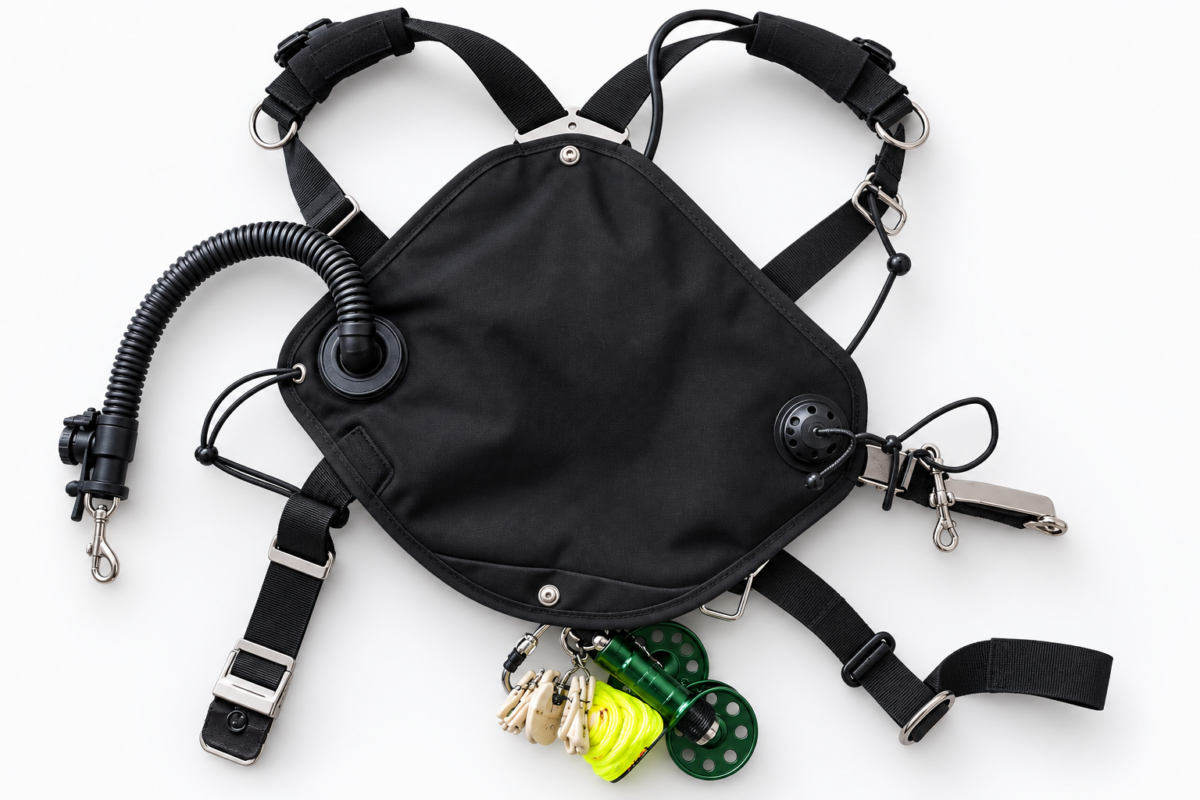
Rather than building the system around a large rigid structure, Razor uses a minimalist harness with a very low-profile wing. Once properly configured, it sits extremely close to the diver.
Razor itself describes the current Razor 4 harness as being developed to be as streamlined as possible and supports both single and loop-bungee configurations.
Why I Like Razor
The biggest advantages for me are:
Excellent streamlining. There is very little unnecessary equipment sticking away from your body.
Highly customisable. Almost everything can be adjusted to the individual diver.
Excellent for restrictions. Its minimalist construction makes sense when you start moving into smaller cave passages.
Good cylinder positioning. Once correctly configured, the cylinders sit very cleanly alongside the body.
Modular. There are numerous ways of modifying bungees, attachment points, weighting and other components.
But that customisation creates Razor’s biggest disadvantage.
The Downside of Razor: Setup
A Razor isn’t something I would recommend buying on Friday and expecting to have perfectly adjusted for Saturday morning’s dive.
It can take time.
Harness length, D-ring positions, bungee length, cylinder attachment and wing position all interact.
Even Razor’s own setup material acknowledges that a new owner may initially feel overwhelmed by the components and that further fine-tuning may be necessary after the initial setup.
Once you’ve got it right, that’s one of Razor’s strengths.
Getting it right is the difficult part.
That is also one reason why proper sidemount instruction should include equipment configuration rather than simply teaching somebody to dive with whatever setup they arrive with.
Buying a Razor Sidemount System
Razor isn’t generally something I direct students to Amazon for.
If you’re coming to Mexico for sidemount or cave training and are interested in buying a Razor sidemount system, contact me directly and I can discuss the system, configuration and training with you.
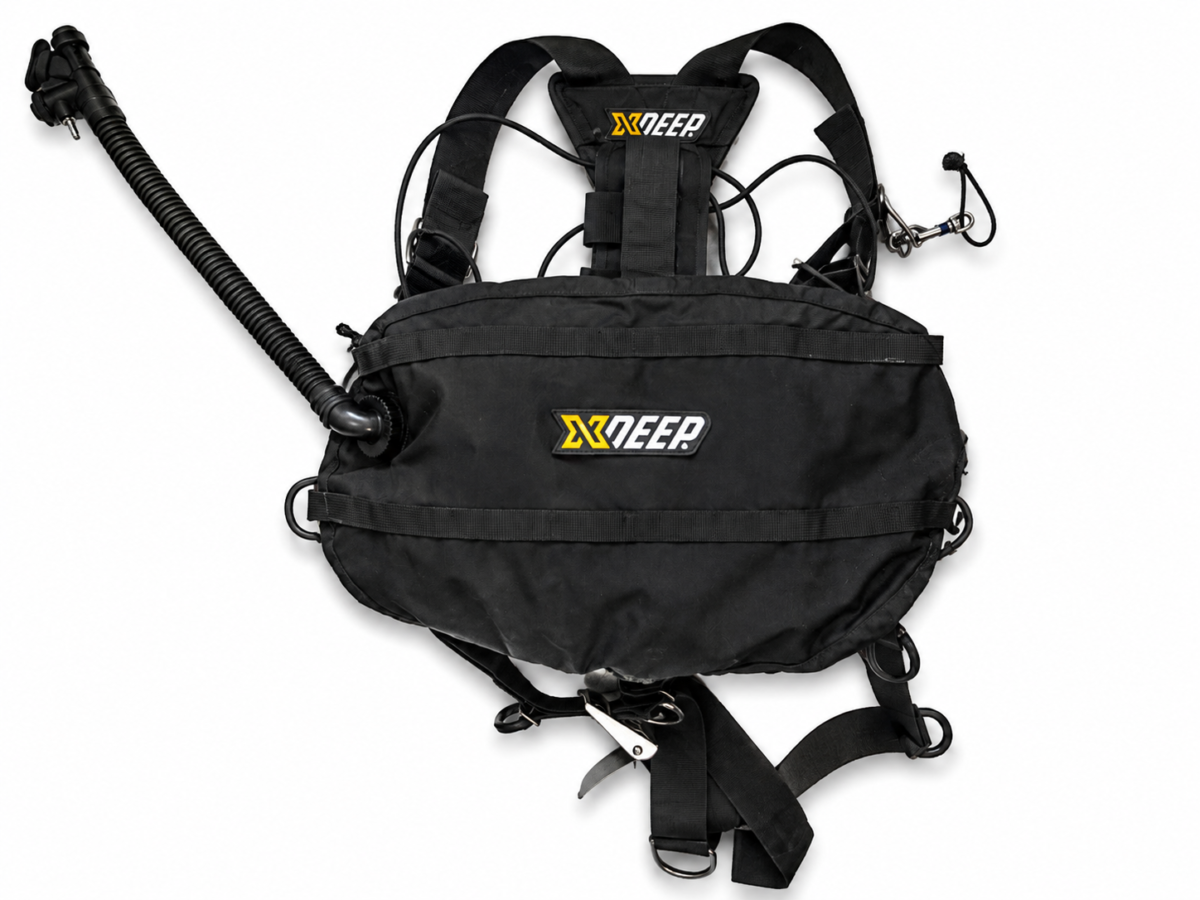
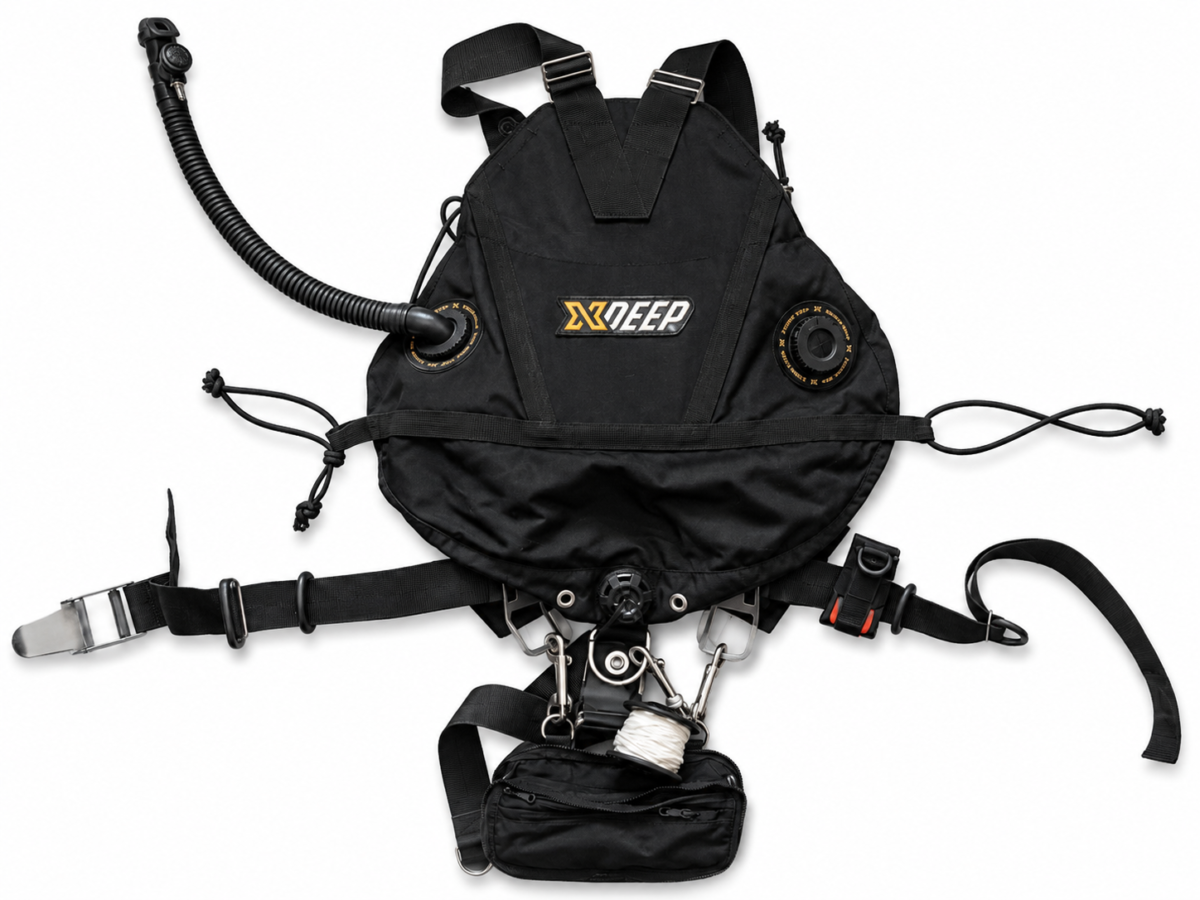
XDEEP Stealth 2.0: The Best Alternative to Razor
If weren’t diving Razor, XDEEP would be very high on my list.
The XDEEP Stealth family has become extremely popular, and for good reason.
It retains the low-profile philosophy that I want from a sidemount system but is generally a little more accessible to somebody who doesn’t want quite as much custom configuration as Razor requires.
I wouldn’t describe XDEEP as completely plug-and-play. Every sidemount system needs to be fitted and adjusted properly.
But it gets you considerably closer.
XDEEP describes the Stealth 2.0 platform as modular and designed for applications ranging from cave exploration to deeper cold-water diving.
XDEEP Stealth 2.0 REC vs TEC
One thing that confuses people shopping for XDEEP is the choice between REC and TEC.
The basic question is:
How much equipment and negative weight do you actually need the wing to support?
For warm-water Mexican cave diving using aluminium cylinders, you don’t necessarily need an enormous wing.
XDEEP REC
For many divers using a normal two-cylinder configuration in warm water, the REC can be entirely adequate.
Even carrying an additional stage cylinder doesn’t automatically mean that you need a huge technical wing.
A smaller wing also has an advantage: less material and less bulk behind you.
XDEEP TEC
If you’re moving towards:
- Multiple stage cylinders
- Steel cylinders
- Drysuits
- Colder water
- Heavier technical equipment
- More negatively buoyant configurations
then the additional capability of the TEC system starts making more sense.
This is an important principle when buying technical equipment:
More isn’t automatically better.
Buy the amount of lift appropriate for the diving you’re actually going to do.
XDEEP Colours: Not Just Cosmetic
One interesting advantage of XDEEP is the availability of different colours.
People getting into technical and cave diving often seem determined to make absolutely everything black.
Black wing.
Black wetsuit.
Black fins.
Black mask.
Black helmet.
It looks cool.
The problem is that your three teammates have done exactly the same thing.
In a cave, particularly at a distance or in reduced visibility, being able to identify another diver quickly can be useful.
Brightly coloured:
- Wings
- Fins
- Helmets
- Exposure suits
- Other identifiable equipment
can help distinguish one team member from another.
So I don’t consider colour purely cosmetic.
Being recognisable underwater has practical value.
Hollis Sidemount BCDs
Hollis produces several sidemount systems, including the SMS series and Katana.
They are perfectly usable sidemount systems, but their design philosophy is somewhat different from Razor and XDEEP.
Hollis SMS75
The SMS75 looks and feels more like a conventional BCD converted around sidemount principles.
For recreational sidemount diving that may appeal to some divers.
For cave diving, I personally prefer less.
There is more structure behind the diver, more hardware and generally more equipment projecting away from the body.
Every extra piece of exposed hardware isn’t automatically dangerous, but when I’m configuring equipment for cave diving my general philosophy is:
If it doesn’t need to stick out, I don’t want it sticking out.
That becomes increasingly important when moving through tighter environments.
Hollis Katana 2
The Katana is a more interesting option.
It’s more streamlined than some of the older Hollis designs and is available in configurations offering redundant buoyancy.
That can be useful for certain types of technical diving.
However, one design feature I particularly consider when evaluating cave equipment is the position of the dump valve.
And that deserves its own section.
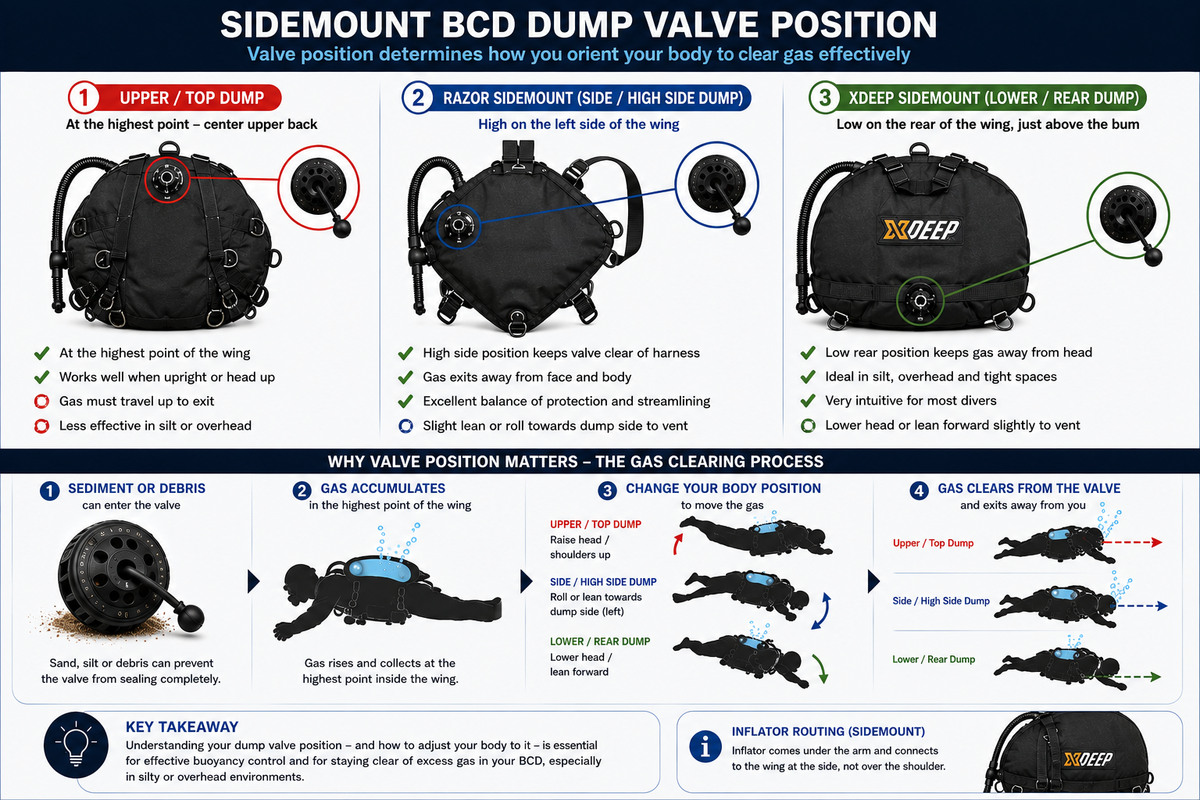
Sidemount Dump Valve Position: Why It Matters
This sounds like a small detail.
It isn’t.
Where the dump valve is positioned changes both how you dump gas and what happens if that valve becomes contaminated or doesn’t seal properly.
Cave diving involves sediment.
Even in extremely clear Mexican caves, divers need to think about what happens when equipment comes into contact with sand, clay or fine particulate material.
Traditional Upper Dump
A more traditional BCD-style dump generally feels intuitive.
You raise the relevant part of your body, pull the dump and release gas.
For somebody transitioning from backmount recreational equipment, this may initially feel very natural.
But I don’t particularly like an upper dump for cave sidemount.
If a valve becomes contaminated with sediment and doesn’t seal properly, its location can become significant.
If the leaking valve is sitting at the highest point of the bladder, gas naturally migrates towards it.
That can allow considerably more gas to escape.
Lower Dump Valve
Razor and XDEEP take a different approach.
With a lower dump, your body movement to dump gas may initially feel less intuitive.
Depending on the exact system and configuration, you may need to roll slightly or change your body angle to bring the dump to the highest point of the wing.
That takes some practice.
But there is another side to it.
If a lower valve isn’t sealing perfectly, changing body position can move the gas away from that valve.
For example, when upright at the surface, the lower part of the bladder isn’t necessarily where the gas naturally wants to accumulate.
That can provide useful options when managing a problem.
This isn’t a substitute for proper equipment maintenance or buoyancy redundancy. It’s simply an example of why component position matters in technical equipment design.
Dump Valve Comparison
| Configuration | Advantage | Disadvantage | My cave-diving view |
|---|---|---|---|
| Upper/shoulder-style dump | Familiar; intuitive head-up dumping | Sediment contamination can be problematic; gas naturally migrates upwards | Not my preferred cave setup |
| Razor low-profile dump | Streamlined; protected positioning | Requires correct body positioning | Excellent once learned |
| XDEEP lower dump | Streamlined and protected | Often requires changing trim/body angle | Excellent cave configuration |
| Multiple dump options | Greater flexibility | More components/possible failure points | Depends on design |
There is an important update here if you’re comparing older Razor equipment with the current generation.
The Razor 4 BAT Wing now incorporates an additional integrated dump mechanism through the inflator elbow, allowing gas to be dumped from the front with either hand as well as using the traditional rear dump. Razor also describes the current rear dump as a very low-profile design.
That makes the current system somewhat different from earlier Razor configurations.
Dive Rite Nomad Ray
Dive Rite has been making technical and cave-diving equipment for a long time, and the Nomad is a well-established sidemount family.
The current Nomad Ray is certainly capable equipment.
However, compared with Razor, I find the overall approach less minimalist.
For my style of Mexican cave diving, I generally want the smallest, cleanest system possible rather than additional structure behind the diver.
That doesn’t make the Nomad a bad sidemount BCD.
It means that my priorities favour Razor or XDEEP.
If you’re comparing systems, consider not simply how comfortable a BCD looks standing on land, but how much of it will actually be projecting away from your body once you’re horizontal underwater.
Scubapro Sidemount Systems
Scubapro also offers sidemount equipment, and some of it can appear attractive because it’s relatively simple and can be significantly cheaper than premium technical systems.
Again, though, I would look carefully at where the bladder sits when inflated.
I prefer a wing that remains extremely tight to the diver.
If the bladder expands substantially outwards from the sides of your back, you’re increasing your profile and potentially creating more contact and entanglement opportunities.
For recreational open-water sidemount that might not matter much.
Inside a cave, my priorities are different.
Razor vs XDEEP: Which Would I Choose?
This is the comparison I think matters most.
| Feature | Razor | XDEEP |
|---|---|---|
| Streamlining | Excellent | Excellent |
| Customisation | Exceptional | Very good |
| Initial setup | More complicated | Easier |
| Fine tuning | Extensive | Moderate |
| Cave diving | Excellent | Excellent |
| Recreational sidemount | Good, but potentially overkill | Excellent |
| Advanced cave | Excellent | Excellent |
| Learning curve | Higher | Lower |
| My preference | Razor | Second choice |
If you’re prepared to spend the time setting everything up correctly, I prefer Razor.
If you want something slightly more straightforward while retaining excellent streamlining and serious cave capability, XDEEP is an extremely good choice.
Sidemount Bungees: One of the Most Important Parts of Your Setup
People spend $800 or $1,000 on a sidemount BCD and then barely think about the piece of elastic holding the cylinders in position.
That’s a mistake.
The bungee system has a major influence on:
- Cylinder position
- Streamlining
- Valve accessibility
- Ease of clipping and unclipping
- Equipment redundancy
- How easily you can manipulate cylinders in restrictions
There isn’t one universally correct configuration.
There are several.
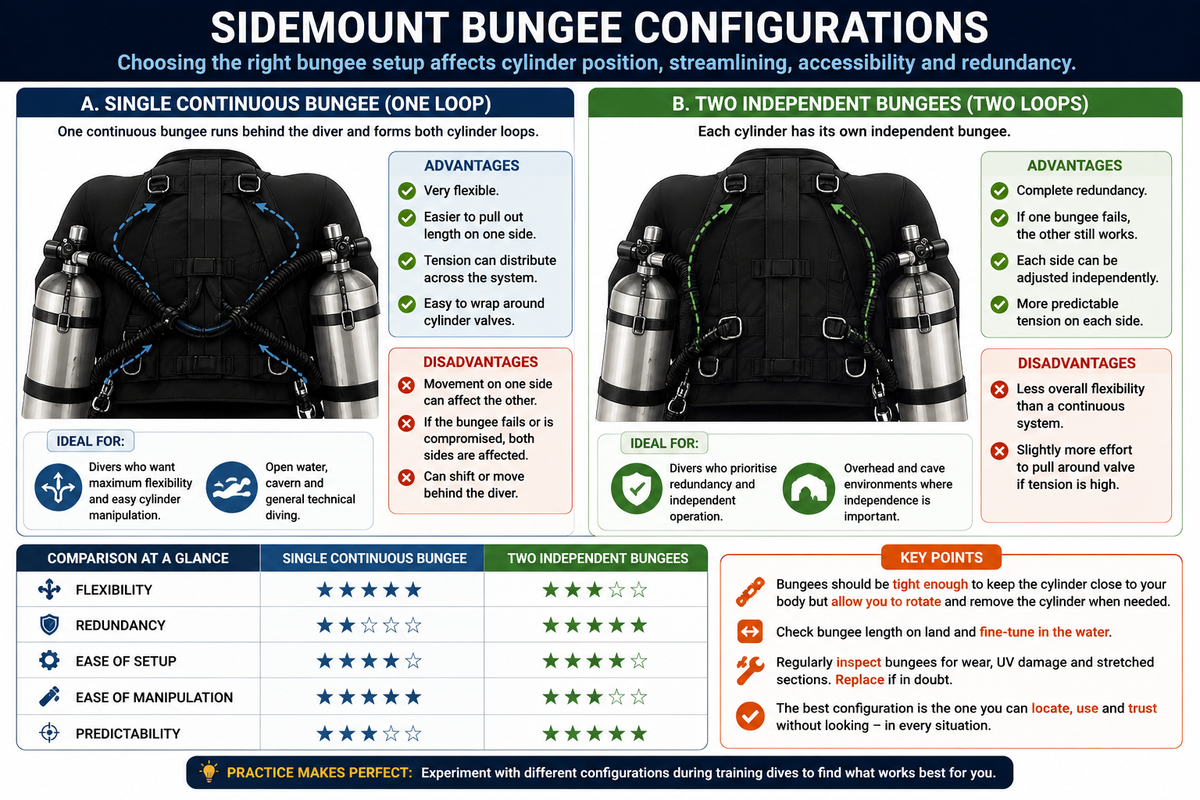
Continuous Loop vs Two Independent Bungees
Continuous Bungee
A continuous bungee runs across the back and creates the attachment system on both sides.
Advantages
The biggest advantage is flexibility.
If you need additional length on one side, the system has some ability to move and redistribute tension.
That can make the bungee easier to grab, stretch around a cylinder valve and manipulate.
Disadvantages
The two sides aren’t completely independent.
Movement on one side can affect the other.
And if the single continuous bungee itself is compromised, you’ve potentially affected both sides of the system.
Two Independent Bungees
Instead of one continuous length, you can run an independent bungee for each cylinder.
Advantages
The major advantage is redundancy.
If one bungee breaks or becomes unusable, the other remains completely independent.
You can also tune the length of each side individually.
Disadvantages
You lose some of the flexibility provided by one continuous piece.
Each bungee has a fixed available length, so correct adjustment becomes particularly important.
Bungee Comparison
| Configuration | Flexibility | Redundancy | Setup | My view |
|---|---|---|---|---|
| Continuous loop | Excellent | Lower | Moderate | Very easy to manipulate |
| Two independent bungees | Good | Excellent | Moderate | Excellent technical option |
Interestingly, the current Razor 4 harness explicitly accommodates both single and loop-bungee configurations, reflecting the fact that experienced sidemount divers use different approaches rather than there being one universally correct system.
Rear-Mounted vs Shoulder-Mounted Bungees
There is another decision.
Where does the bungee terminate?
Both Ends Towards the Back
Running the bungees from behind the diver creates a very clean configuration.
The downside is accessibility.
Depending on the diver, exposure protection and exact harness adjustment, the bungee can sometimes move around behind you.
You know roughly where it is.
But you can’t see it.
And occasionally you find yourself reaching around trying to locate it.
One End Attached Near the Shoulder
Another approach is to terminate one end around the shoulder area.
I personally find this easier to locate.
Your hand naturally knows where your shoulder D-ring and webbing are, so the bungee becomes more predictable and accessible.
That can be particularly useful when manipulating equipment while maintaining position in a cave.
Should You Put Bolt Snaps on Sidemount Bungees?
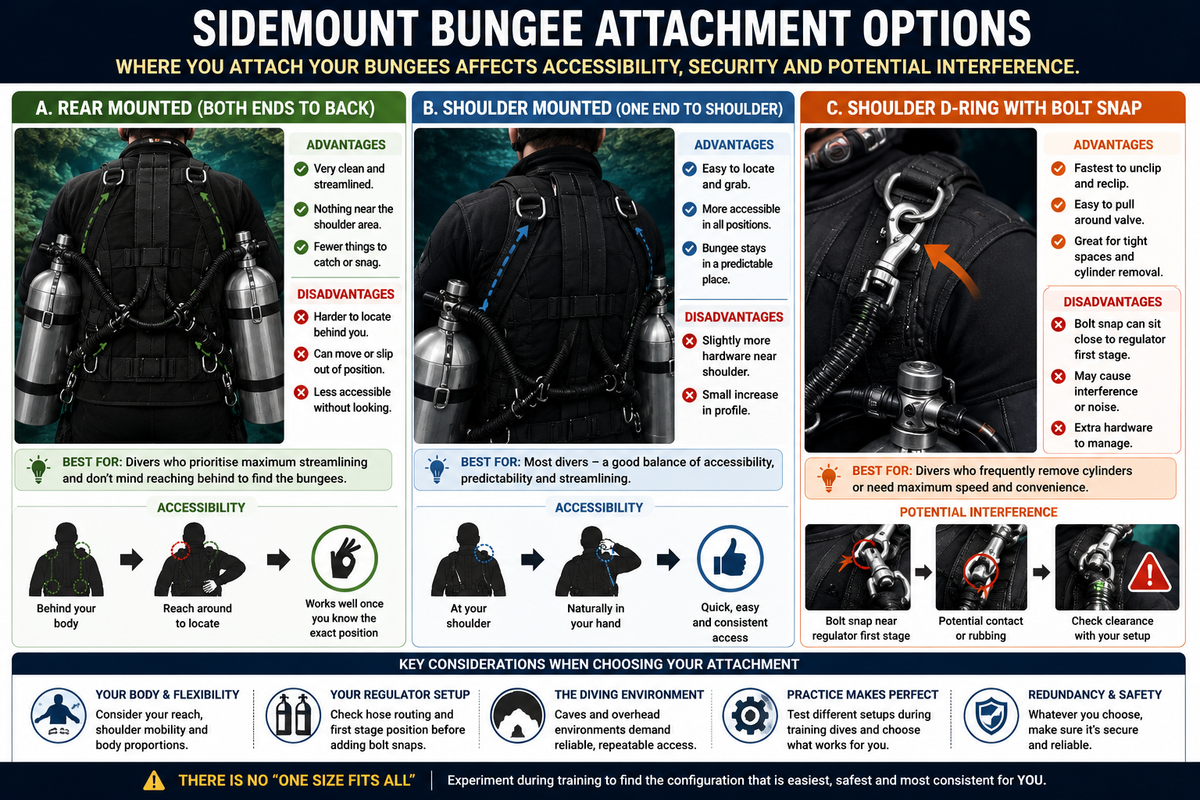
Another option is attaching a single-ended bolt snap to the bungee.
That allows you to:
- Unclip the bungee.
- Pull it around the cylinder valve.
- Reclip it to the shoulder D-ring.
It can make manipulating the bungee extremely easy.
But there is a downside.
The bolt snap can sit close to the first stage.
Depending on your regulator and hose configuration, the metal clip may contact the regulator first stage.
That can become annoying and creates another piece of hardware in an area where I’m generally trying to keep things as clean as possible.
Again, there isn’t a universally correct answer.
The best setup is the one you can reliably locate, manipulate and operate while maintaining trim and without looking at it.
Redundant Buoyancy: Do You Need Two Bladders?
This is another area where technical divers sometimes fall into the trap of assuming:
More redundancy = more safety.
Not necessarily.
Redundancy is useful when it solves a realistic failure.
But every additional component also introduces:
- More hoses
- More valves
- More complexity
- More maintenance
- More potential failure points
The current Razor 4 system is available with a redundant BAT wing, with the backup bladder protected between the primary wing and weight layer.
Some XDEEP configurations and other technical systems can also accommodate redundant buoyancy solutions.
Whether you need that depends heavily on your diving.
Warm-Water Mexican Cave Diving
In the Mexican cenotes, we’re commonly diving:
- Aluminium cylinders
- Wetsuits
- Relatively little weight
- Warm freshwater
A correctly weighted diver shouldn’t require enormous amounts of BCD lift simply to remain neutrally buoyant.
That changes when you introduce:
- Heavy steel cylinders
- Drysuits
- Multiple stages
- Decompression cylinders
- Cold-water equipment
- Significant negative buoyancy
For more demanding technical configurations, redundant buoyancy becomes much more important.
That might be a redundant bladder, a drysuit where appropriate, or another properly planned method of generating emergency buoyancy.
This should be part of the overall dive-system design rather than simply buying the BCD with the largest number of features.
Don’t Forget the Rest of Your Sidemount Equipment
A good sidemount BCD won’t compensate for badly selected equipment elsewhere.
Two areas particularly worth considering are your fins and mask.
For cave diving, I generally prefer stiff paddle-style fins that work efficiently with frog kicks, modified frog kicks, helicopter turns and back kicks.
Read my full guide:
A low-volume, properly fitting mask is equally important, and cave divers should also consider carrying an appropriate backup.
Read:
What Sidemount BCD Do I Recommend?
For the diving I actually do and teach in Mexico, my first choice is:
1. Razor — My Choice for Cave Diving
Extremely streamlined, extremely customisable and excellent in restrictions.
The disadvantage is that you need to spend the time getting it properly configured.
2. XDEEP Stealth 2.0 — Best Alternative
Excellent streamlining with a slightly easier path towards getting the equipment configured correctly.
For many recreational and newer sidemount divers, this may actually be the more straightforward purchase.
3. Hollis / Dive Rite — Capable Alternatives
Both manufacturers make perfectly capable sidemount equipment.
I simply prefer the more minimalist philosophy of Razor and XDEEP for the Mexican cave environment.
Learn Sidemount Diving in Mexico
Buying a good sidemount system is only the beginning.
The difference between a badly configured sidemount diver and a properly configured one can be enormous.
Small adjustments to:
- Harness position
- Cylinder height
- Bungee tension
- D-rings
- Bolt snaps
- Hose routing
- Weight distribution
- Wing position
can completely change how the system feels underwater.
My sidemount courses in Tulum aren’t based around simply completing a list of skills.
We spend time configuring the equipment for the individual diver, getting the cylinders into the correct position and then refining the setup in the water.
That is particularly important if your eventual goal is cavern or cave diving.
Frequently Asked Questions About Sidemount BCDs
What is the best sidemount BCD for cave diving?
My personal preference is Razor, particularly for Mexican cave diving, because of its extremely streamlined and highly configurable design. XDEEP Stealth 2.0 is my strongest alternative and may be easier for some divers to initially configure.
Is XDEEP better than Razor?
Neither is universally better. Razor offers exceptional customisation and minimalism but requires more setup and fine-tuning. XDEEP is also highly streamlined while generally being somewhat easier to configure.
Is sidemount good for cave diving?
Yes. Sidemount offers excellent redundancy, cylinder accessibility and streamlining and allows divers to manipulate cylinders when necessary. However, sidemount itself doesn’t qualify somebody to enter a cave. Appropriate cave training is essential.
Should I buy XDEEP REC or TEC?
That depends on the cylinders, exposure protection and amount of equipment you’re carrying. For many warm-water sidemount divers using aluminium cylinders, a recreational configuration can provide sufficient lift. Heavier technical configurations may justify the greater capacity of a TEC system.
Do I need a redundant bladder for sidemount?
Not necessarily. It depends on how negatively buoyant your complete diving system can become and what other redundant buoyancy options are available. For heavy technical configurations, redundant buoyancy becomes increasingly important.
Is a continuous sidemount bungee better than two separate bungees?
A continuous bungee offers excellent flexibility and can be easier to manipulate. Two independent bungees provide greater redundancy because failure on one side doesn’t automatically compromise the other. Both configurations can work extremely well when correctly adjusted.
Why is sidemount equipment setup so important?
Small changes to bungee length, harness adjustment, D-ring position and cylinder attachment can dramatically alter trim and streamlining. Sidemount equipment should therefore be fitted to the individual diver rather than treated like a conventional off-the-shelf BCD.