Choosing the best scuba mask sounds as though it should be simple.
Search online, find the mask with the best reviews, order it and go diving.
Unfortunately, masks don’t really work like that.
I’ve been working in the diving industry for well over a decade, and today much of my diving is technical and cave diving in the cenotes of Mexico. If there is one thing I’ve learnt about masks, it’s this:
The best scuba mask is the one that fits your face.
You can spend $200 on a premium mask and still have a miserable dive if it leaks. Meanwhile, a simple $40 mask that fits properly can give you years of perfectly good diving.
That doesn’t mean all masks are the same.
Low-volume masks, frameless masks, single and twin lenses, clear and black silicone, prescription lenses, mirrored lenses and various specialist designs all have advantages and disadvantages.
For technical and cave diving, I also look at masks rather differently from someone buying a mask for an annual Caribbean holiday.
So rather than simply giving you another list of the “10 best scuba masks”, I’m going to explain what these differences actually mean and what I look for when choosing a mask.
Affiliate disclosure: This article contains affiliate links. If you purchase through one of these links, Best Cenote Dives may receive a small commission at no additional cost to you. I only recommend equipment that I believe is relevant to divers, and inclusion does not mean I have personally used every product mentioned.
Table of Contents
Scuba Mask Types: What’s the Difference?
| Mask type | Main benefits | Possible drawbacks | Best for |
|---|---|---|---|
| Low-volume mask | Less air space, easier to equalise, easier to clear, sits closer to the face and usually offers good visibility | Fit can feel closer or tighter | Cave, technical and freediving, plus divers who want a compact mask |
| Single-lens mask | Wide, uninterrupted view across the front of the mask; often feels more open | Usually cannot take simple drop-in prescription lenses | Divers who prefer a wide, unobstructed field of vision |
| Twin-lens mask | Can be very low volume; compact design; prescription lenses are available for some models | Centre nose bridge divides the view | Technical and recreational diving, particularly if prescription lenses are required |
| Frameless mask | Flexible, compact and easy to pack; often low volume; makes an excellent backup mask | Softer construction can make some models slightly more awkward to handle | Cave and technical diving, travel and backup masks |
| Framed mask | More rigid structure; wide choice of designs and lens configurations | Usually bulkier than a frameless mask | Recreational diving and divers who prefer a more structured mask |
| Black silicone skirt | Reduces peripheral light and reflections; helps focus your vision; particularly useful with dive lights | Can feel slightly less open than clear silicone | Cave, technical, photography and serious diving |
| Clear silicone skirt | Allows more ambient light into the mask and can create a brighter, more open feeling | More reflections and peripheral light; clear silicone can discolour with age | Recreational diving, beginners and divers who dislike an enclosed feeling |
My Quick Recommendations
If you don’t want to read the whole guide, these are the broad categories I would look at.
Best for cave and technical diving:
A simple, low-volume mask with black silicone and a good field of vision.
Best premium option:
Atomic Aquatics makes exceptionally comfortable masks with very soft silicone, although they come at a premium price.
Best for maximum uninterrupted visibility:
A good-quality single-lens frameless mask.
Best traditional option:
A twin-lens mask from an established diving manufacturer such as Scubapro, Cressi, Mares or similar.
Best for divers who need reading assistance:
A mask designed for optical/bifocal lenses or a suitable stick-on magnifying insert.
But before buying any of them, fit the mask to your face.
That’s more important than anything else on this page.
Fit Is More Important Than Brand
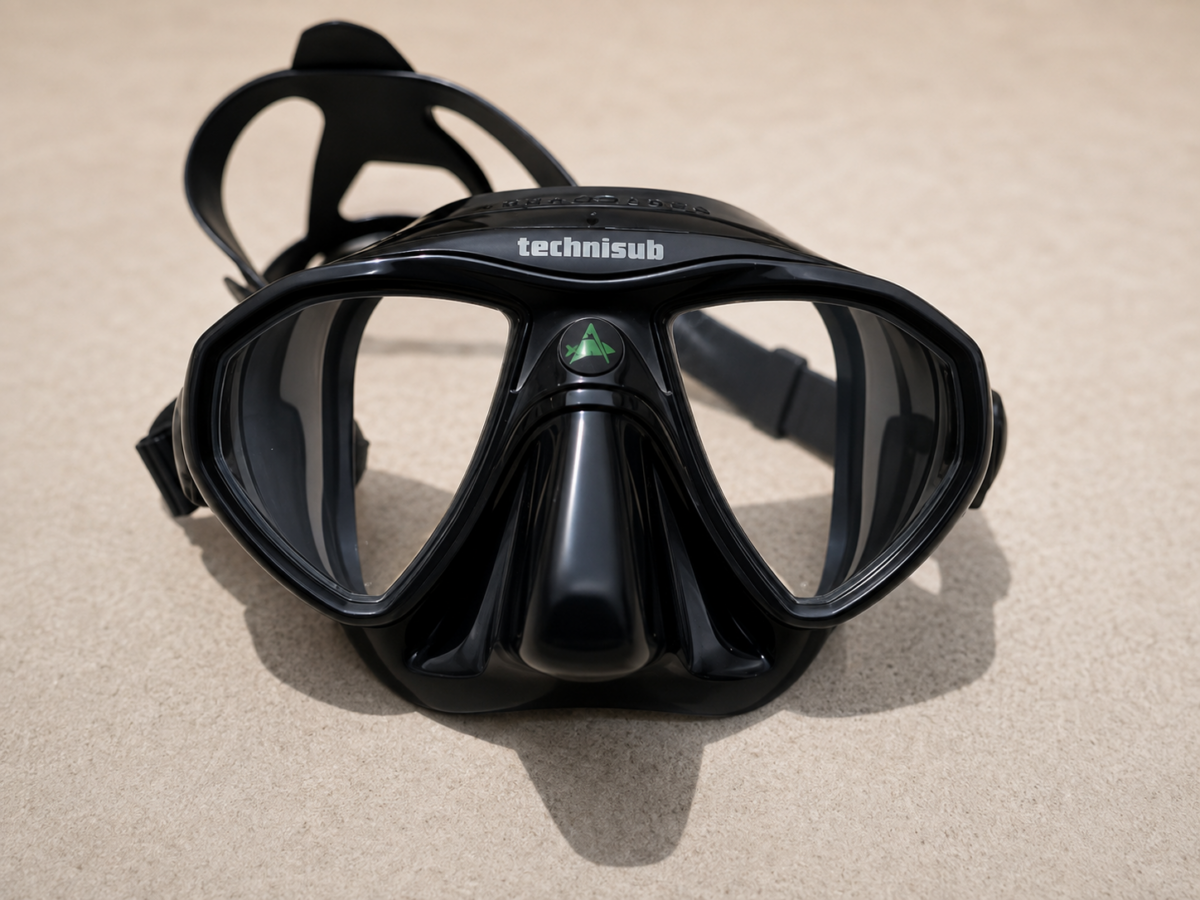
People often ask instructors which brand makes the best scuba masks.
Atomic? Scubapro? Cressi? Mares? Aqualung?
They’re all capable of making good masks.
The problem is that they can’t all make a mask specifically for your face.
People have different-sized faces, different cheekbones, different distances between their nose and upper lip, different nose shapes and different forehead structures.
A mask I absolutely love might leak continuously on you.
That’s why, wherever possible, I recommend trying a mask before buying it.
How to Check Whether a Scuba Mask Fits
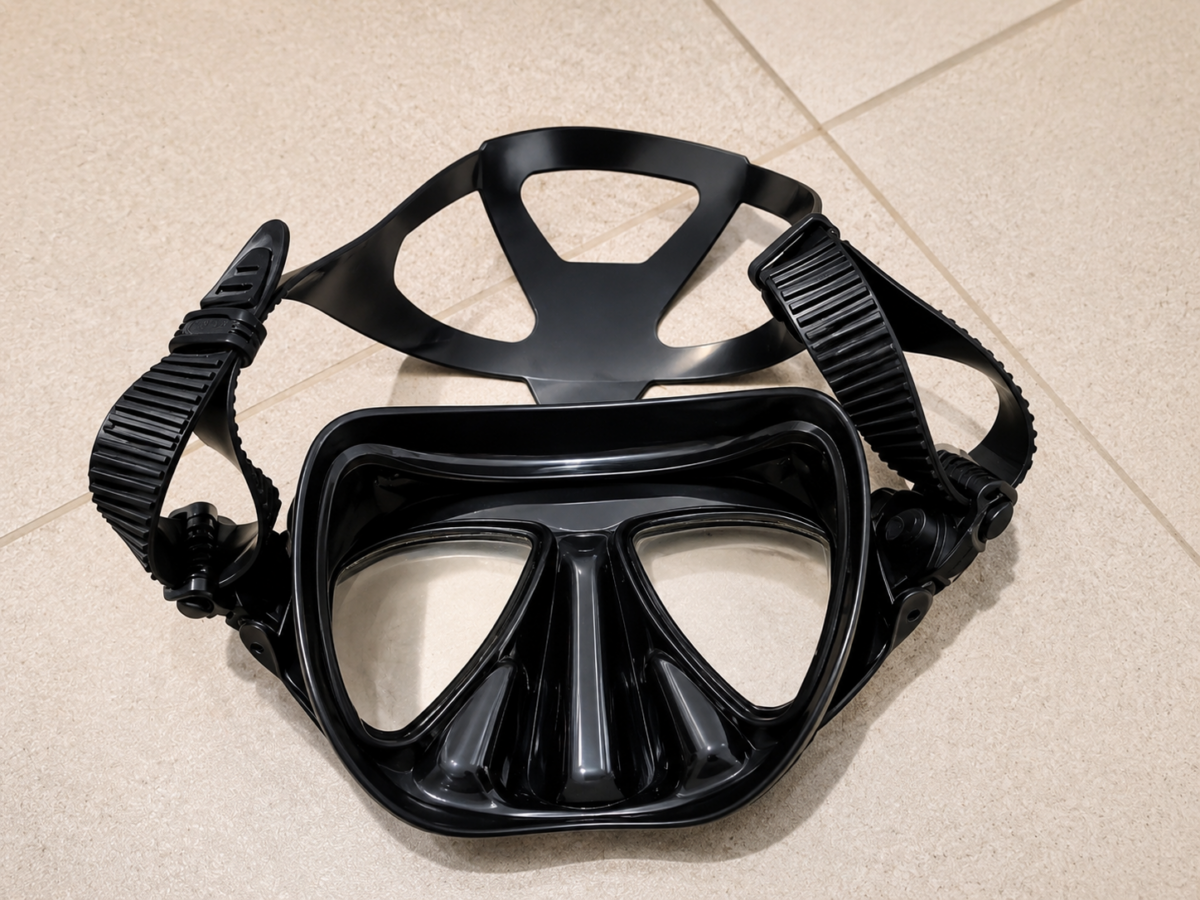
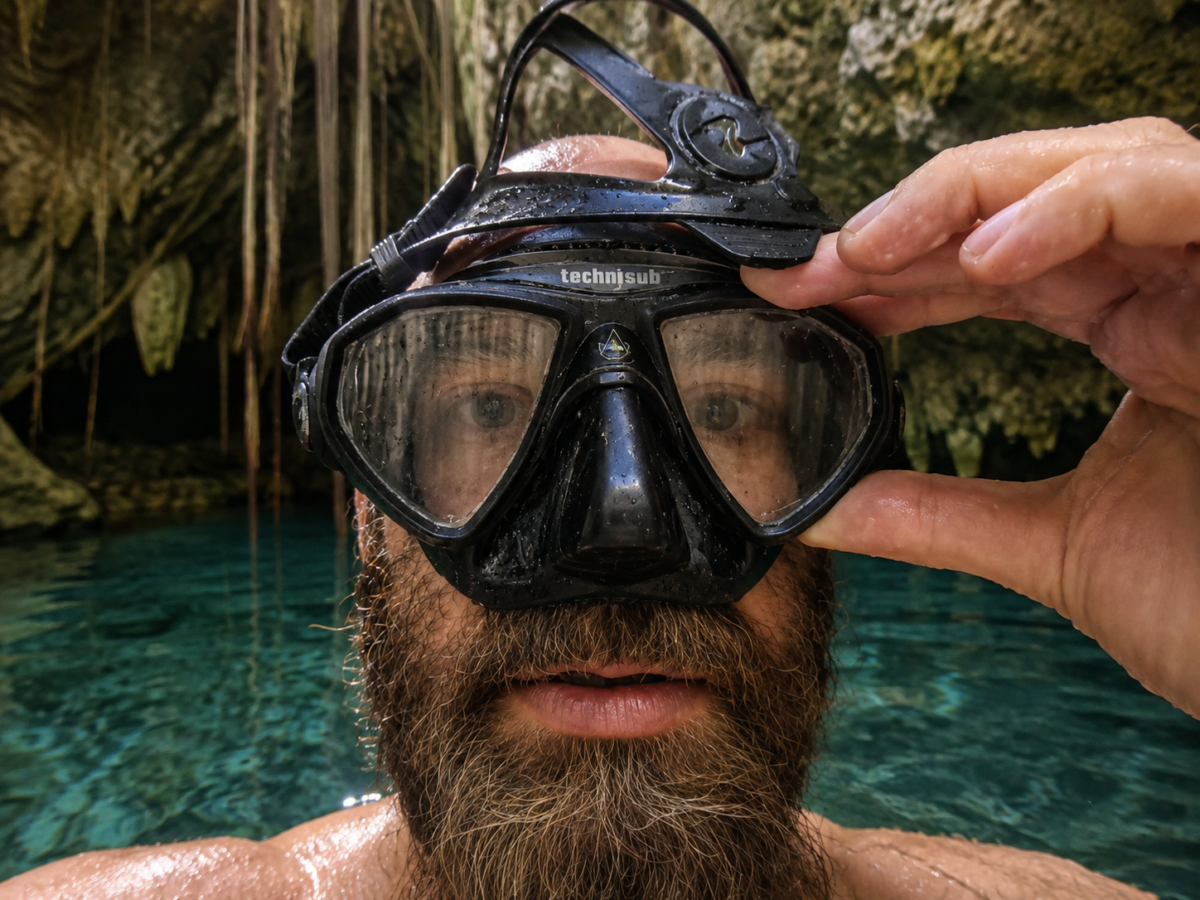
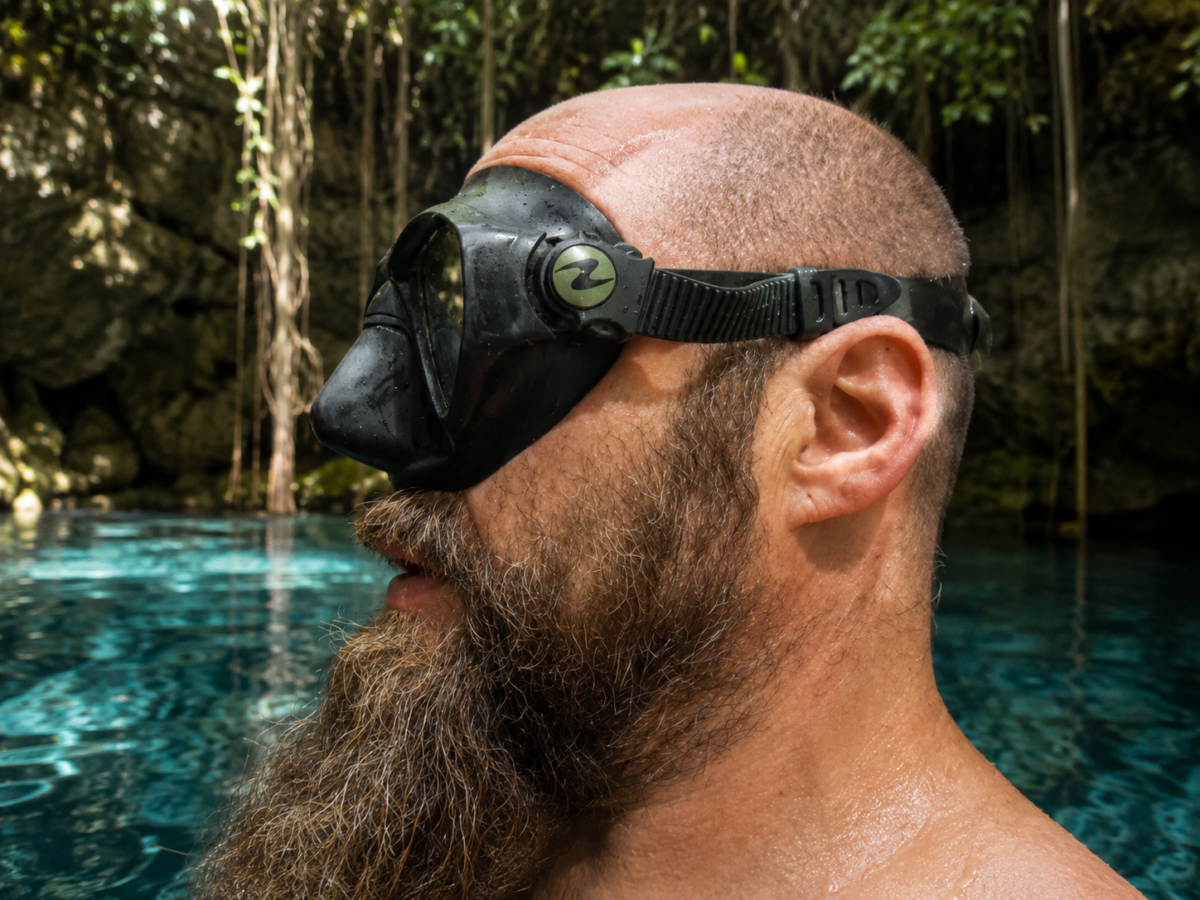
A common test is to put the mask against your face without putting the strap around your head.
Gently breathe in through your nose.
The mask should pull against your face and remain there without you having to hold it.
You don’t need to inhale as though you’re trying to vacuum-pack your head. You’re simply checking whether the skirt can form a seal around your face.
Also look carefully around the mask skirt.
Hair, moustaches and facial hair can interfere with the seal, as can a skirt that sits in the wrong position beneath your nose.
Then check comfort.
Does the frame push against the bridge of your nose? Does it press uncomfortably against your forehead? Can you easily pinch your nose?
A mask can pass the suction test and still be uncomfortable after an hour underwater.
Why I Prefer Low-Volume Scuba Masks
My personal preference is for low-volume masks.
“Volume” refers to the amount of air space between your face and the mask lens.
A low-volume mask places the glass closer to your eyes and face.
There are several advantages.
Firstly, there’s less air inside the mask.
That means you generally need less air to equalise the mask as you descend and less air to clear it if it floods.
The lens sitting closer to your eyes can also give you an excellent field of vision despite the mask itself being relatively compact.
For recreational diving, these differences aren’t necessarily revolutionary.
For technical diving, freediving and particularly cave diving, however, I like equipment to be simple, compact and streamlined.
I don’t want unnecessary bulk attached to my face.
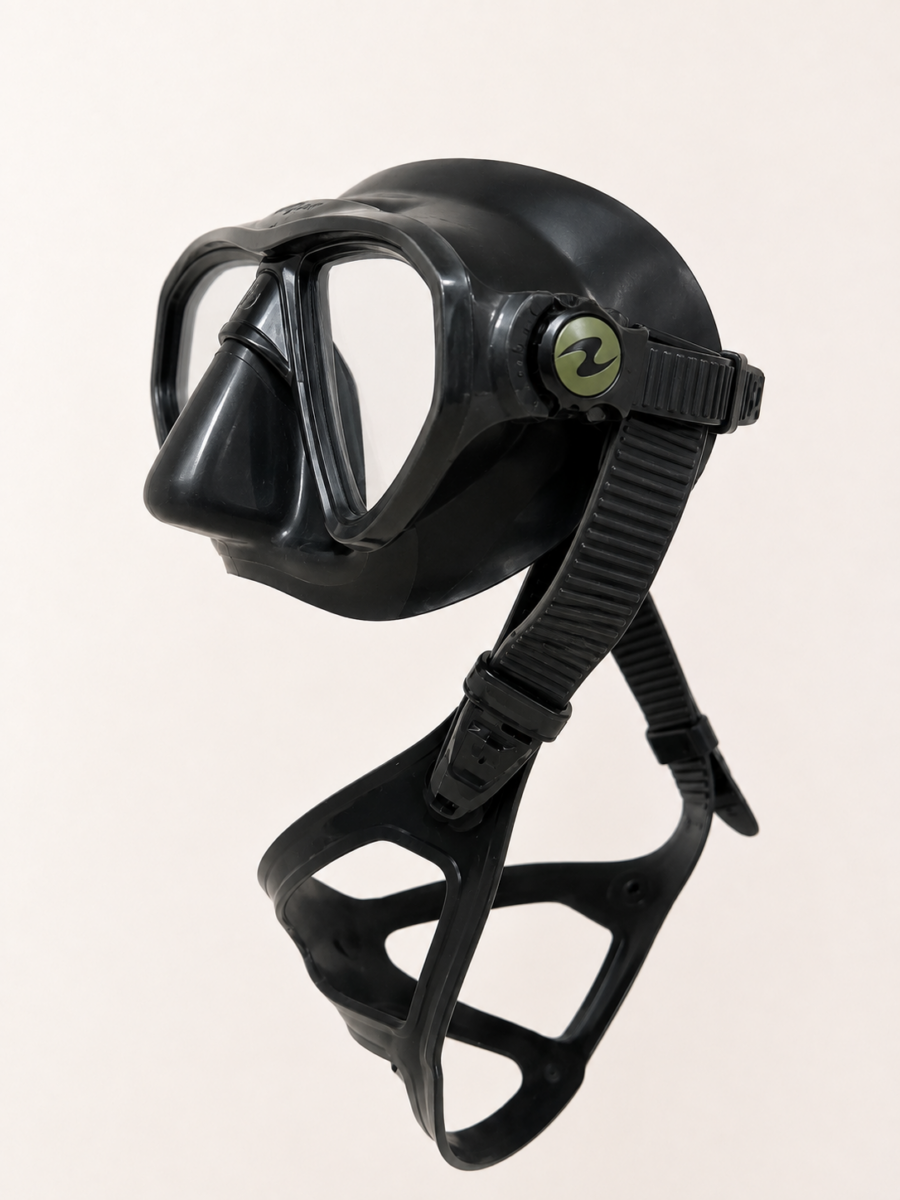
My Aqualung Micromask
I’ve used an Aqualung Micromask-style low-volume mask for my own diving, and this is the general design I prefer.
It is compact, the lenses sit close to the eyes and there isn’t much unnecessary mask sticking out from the face.
That suits the type of diving I do.
However, I wouldn’t tell somebody that they must buy the same mask.
If it doesn’t fit your face, it’s the wrong mask for you.
Single-Lens vs Twin-Lens Scuba Masks
One of the most obvious differences between masks is whether they use one large piece of glass or two separate lenses.
Neither is automatically better.
Single-Lens Masks
Single-lens masks give you one uninterrupted window across the front of your face.
Some divers really like the open feeling this creates.
Modern frameless single-lens masks can also be very comfortable because the silicone body forms much of the structure of the mask.
Examples include designs such as the Atomic Aquatics Frameless range and Aqualung Plazma.
Atomic in particular is known for very soft silicone, which can feel excellent against the face.
The downside is price. Premium masks can become surprisingly expensive.
And again, a $180 mask that doesn’t fit you isn’t better than a $50 mask that does.
Twin-Lens Masks
Twin-lens masks use two separate pieces of glass divided by the nose bridge.
This is probably what many people imagine when they picture a conventional modern scuba mask.
There are countless variations, ranging from simple Cressi designs to masks such as the Scubapro Zoom.
Twin lenses also make certain optical corrections easier because the left and right lenses can potentially have different prescriptions.
For me, the choice between single and twin lenses comes considerably below fit, comfort and volume.
Frameless vs Framed Scuba Masks
A traditional framed mask has a rigid structure holding the lenses and skirt together.
A frameless mask bonds the silicone skirt more directly to the lens.
Frameless masks can therefore be compact, flexible and easy to pack.
They’re particularly popular with technical divers because a frameless backup mask can fold relatively flat into a pocket.
Framed masks aren’t somehow obsolete, though.
A good framed mask can be extremely durable, and some designs allow interchangeable optical lenses.
Choose based on what fits and what features you actually need rather than assuming “frameless” automatically means better.
Clear Silicone vs Black Silicone
You’ll see scuba masks with clear, coloured and black silicone skirts.
For recreational diving in bright tropical water, clear silicone can create a very open, bright feeling.
It also allows more light into your peripheral vision.
Some photographers like clear skirts because more of the diver’s face is visible.
For cave diving, I generally prefer black silicone.
In a dark environment, I want my attention directed through the lenses towards what I’m actually looking at rather than having stray light entering through the sides of the mask.
Black silicone also tends to retain its appearance better. Clear silicone can gradually discolour.
This isn’t a safety rule. It’s primarily preference and environment.
What Makes a Good Cave Diving Mask?
Cave diving changes my priorities considerably.
I want:
- low volume
- excellent fit
- black silicone
- good downward visibility
- simple construction
- a compact profile
- easy equalisation
- minimal snag points
I’m not particularly interested in whether the mask looks fashionable.
Cave equipment should solve problems rather than create them.
I also carry a backup mask.
A mask failure in open water is inconvenient. In an overhead environment, equipment redundancy becomes much more important.
A compact frameless or low-volume mask makes a good backup because it can fit into a drysuit or technical-diving pocket without taking up much room.
Choosing a Mask for a Larger Face
Low volume doesn’t necessarily mean suitable for everybody.
Some divers simply have larger or broader faces and are more comfortable with a larger mask.
That’s fine.
There are high-volume and wide-view masks designed around larger facial profiles.
They can also expose more of the face, which some divers prefer for photography.
This brings us back to the central point of this article:
Don’t buy a mask because somebody with a completely different face says it fits them perfectly.
Their review can tell you about build quality.
It cannot tell you whether the mask fits your face.
Prescription Scuba Masks and Reading Your Gauges
This becomes increasingly relevant as divers get older.
You might be able to see perfectly well across a reef but struggle to read your dive computer when it’s 30 centimetres from your face.
There are several solutions.
Prescription Optical Lenses
Some twin-lens masks allow the standard lenses to be replaced with corrective lenses.
Depending on the mask, different strengths may be available for each eye.
This is one advantage of designs such as the Scubapro Zoom and similar optical-compatible masks.
For a more complicated prescription, you can also investigate specialist prescription mask lenses.
Bifocal Scuba Masks
Another option is a mask with magnification incorporated into the lower portion of the lens.
The principle is similar to reading glasses.
Look forward and you have normal distance vision.
Look down towards your computer or pressure gauge and the magnified area helps you read it.
Products such as the XS Scuba Gauge Reader are designed around this idea.
Stick-On Reading Lenses
A cheaper solution can be a pair of small magnifying inserts placed inside your existing mask.
DiveOptx-style inserts are one example.
These can be useful if your main problem is simply reading a computer or gauges rather than correcting your entire field of vision.
Tinted, Mirrored and Polarized Scuba Masks
Tinted and mirrored masks certainly look cool.
Various manufacturers offer amber, coloured or mirrored lens treatments, and some lenses are designed to alter contrast or reduce brightness.
One important point: mirrored, tinted and polarized don’t necessarily mean the same thing.
If polarization is important to you, check the manufacturer’s actual specification rather than assuming a coloured or mirrored lens is polarized.
For the diving I do, I generally prefer clear lenses.
And there’s another reason for that.
Why I Like to See a Diver’s Eyes
As an instructor, someone’s eyes give me useful information.
You can often see when a student is becoming uncomfortable, confused or stressed before the situation develops any further.
Eye contact is also an extremely useful form of communication.
That’s particularly important when somebody is anxious.
With heavily mirrored lenses, I can’t see their eyes.
If I’m the one wearing the mirrored mask, they can’t see mine either.
Personally, if I’m approaching a stressed diver, I’d much rather they could see my eyes and expression than effectively be looking back at their own reflection.
For recreational diving this may never matter.
For instruction and technical diving, I prefer function over fashion.
Ear-Protecting Scuba Masks
One of the stranger-looking specialist designs is the IST ProEar.
It combines a conventional mask with covers over the ears connected to the mask’s air space.
This isn’t something most divers need.
However, some divers who have recurring ear problems or particular equalisation issues like this type of system.
The important thing is to understand that it’s specialist equipment rather than a generally “better” scuba mask.
If you’re considering one because of a medical ear problem or difficulty equalising, it’s also sensible to discuss diving with a physician experienced in diving medicine rather than relying on equipment to solve an underlying problem.
Traditional Oval Diving Masks
You’ll occasionally see old-fashioned oval masks that look as though they belong in a Jacques Cousteau documentary or an early James Bond film.
And they do look fantastic.
The large window also exposes more of the diver’s face, which can make them attractive for photography or filming.
From a purely practical modern scuba perspective, however, they wouldn’t be my first choice.
Modern low-volume masks generally give you a more compact design and easier access to the nose for equalisation.
Any scuba mask must also allow you to introduce air through your nose into the mask as you descend.
That’s important because the mask itself must be equalised.
Why You Need to Equalise Your Scuba Mask
Beginners sometimes think equalisation only applies to their ears.
It doesn’t.
As you descend, increasing water pressure compresses the air inside your mask.
If you don’t add air, the mask can become increasingly uncomfortable and eventually cause mask squeeze.
Fortunately, preventing this is simple.
Occasionally exhale a small amount of air through your nose into the mask while descending.
This is another reason your nose must be enclosed within a scuba mask.
Full-Face Snorkelling Masks Are NOT Scuba Masks
This distinction is extremely important.
You’ve probably seen full-face snorkelling masks online. They cover the entire face and have an integrated snorkel at the top.
They are designed for surface snorkelling.
They are not conventional scuba masks.
You cannot simply descend wearing one and put a normal scuba regulator in your mouth because your mouth is enclosed inside the mask.
There are genuine full-face masks designed specifically for scuba diving, but they’re completely different pieces of equipment with appropriate breathing-gas connections and training considerations.
Don’t confuse the two.
Do I Recommend Full-Face Snorkelling Masks?
Personally, I prefer a conventional mask and snorkel.
A conventional setup separates the mask from the breathing system and is simple, proven and easy to remove.
Full-face snorkelling masks rely on their airflow design to manage inhaled and exhaled gas. If considering one, use a reputable product designed and tested for the purpose, follow its instructions carefully and use it only for the activity for which it was designed.
For scuba diving, buy a proper scuba mask.
GoPro-Mounted Scuba Masks: Why I Don’t Recommend Them
These seem like a brilliant idea.
Put the GoPro on your mask and record everything you see.
Unfortunately, I think they’re a solution looking for a problem.
Your head isn’t a camera tripod.
While diving, you’re constantly looking at your buddy, gauges, computer, the environment and potential hazards.
Your video consequently follows every head movement.
A handheld camera gives you much more control over composition and allows you to deliberately point the camera at what you want to record.
For cave diving, I have an additional objection.
I don’t want unnecessary snag points attached to my head.
Guideline management is extremely important in cave diving.
Adding a camera and mounting system to the top of your mask introduces another protrusion that a line could potentially catch.
More importantly, that protrusion is attached to the equipment keeping water out of your eyes.
I don’t want something catching the camera and pulling my mask away from my face.
My recommendation?
Carry the GoPro in your hand.
If appropriate, use your other hand to position a light. You’ll generally get more controlled footage without attaching unnecessary equipment to your mask.
Best Cenote Dives verdict: Not recommended for cave diving.
How Much Should You Spend on a Scuba Mask?
You can find scuba masks from around $20 to well over $200.
Do you need a $200 mask?
No.
Premium masks may offer extremely soft silicone, excellent glass, sophisticated buckles and very good build quality.
Those things can be nice.
But price doesn’t overcome poor fit.
For most divers, I’d rather see them spend $50–$100 on a mask that fits beautifully than $180 on one they bought because it looked impressive online.
And don’t dismiss relatively inexpensive masks.
A simple mask from a reputable diving manufacturer can last for years.
How to Prepare a New Scuba Mask
One of the classic frustrations is buying a beautiful new mask and discovering that it fogs continuously.
New tempered-glass masks can have manufacturing residue on the inside of the lens.
That needs to be removed before the mask performs properly.
There are various manufacturer-recommended cleaning products and mask-preparation methods.
Follow the instructions for your particular mask because not every modern lens coating should be treated the same way.
You may have heard divers recommend using a flame on the inside of a new lens.
I wouldn’t make that your default approach.
Some masks have coatings, plastics or silicone components that can be damaged by excessive heat. Follow the manufacturer’s instructions instead.
How to Stop a Scuba Mask Fogging
Once the mask has been prepared properly, anti-fogging is relatively straightforward.
Commercial mask defog is inexpensive and works well.
Traditionally, divers have also used saliva, although commercial defog is the cleaner option when you’re sharing or renting equipment.
Apply a small amount to the inside of the lenses before entering the water, spread it around and rinse according to the product instructions.
Avoid repeatedly touching the inside of the lens afterwards.
And remember:
A mask that continually fogs despite defog treatment may not have been properly prepared in the first place.
How to Clear a Scuba Mask Underwater
Mask clearing is one of the first skills scuba divers learn.
If water enters the mask, look slightly downward or forward depending on the mask design, press gently against the upper frame and exhale through your nose as you slowly raise your head to look at the sky.
The air pushes the water towards the lower skirt and out.
With practice, you don’t even need to think about it.
This is another small advantage of low-volume masks: there’s simply less internal space to clear.
Being comfortable without a mask is also an important diving skill.
Equipment can fail.
A broken strap or displaced mask shouldn’t automatically become an emergency for a trained diver.
Caring for Your Scuba Mask
A decent mask can last for many years.
After diving, particularly in salt water:
Rinse it thoroughly in fresh water.
Allow it to dry away from intense direct sunlight.
Don’t leave it cooking inside a closed car.
Store it where the silicone isn’t permanently crushed or distorted.
Check the strap, buckles and skirt periodically for deterioration.
And if you regularly cave or technical dive, consider replacing a questionable mask before it becomes a failure rather than waiting until it breaks underwater.
Should You Carry a Spare Scuba Mask?
For ordinary recreational diving, carrying a second mask underwater isn’t standard practice.
For cave and technical diving, it’s a different story.
I carry a backup.
If my primary mask becomes unusable inside a cave, I don’t want my entire ability to see to depend upon getting that mask working again.
A compact backup mask takes relatively little pocket space.
Again, this demonstrates an important difference between recreational and technical equipment choices.
Technical divers don’t necessarily buy equipment because it has the most features.
Quite often we’re doing the opposite.
We’re removing unnecessary complexity.
Best Scuba Mask FAQ
What is the best scuba mask?
The best scuba mask is one that fits your face correctly, remains comfortable and suits the type of diving you do. Brand and price come after fit.
Are expensive scuba masks better?
Sometimes they use softer silicone, better-quality components or sophisticated lens technology, but an expensive mask that doesn’t fit will still leak. You don’t need a premium mask to enjoy excellent diving.
Are low-volume scuba masks better?
They have several advantages, including less internal air space, easier clearing and a compact profile. I particularly like them for cave and technical diving, but some divers find larger masks more comfortable.
Is a single-lens or twin-lens scuba mask better?
Neither is universally better. Single lenses provide an uninterrupted view, while twin-lens masks can be compact and may make optical correction easier. Fit matters more.
Are frameless scuba masks better?
Frameless masks can be compact, flexible and excellent as primary or backup masks. A well-designed framed mask can be equally good and may offer replaceable optical lenses.
Should I buy a clear or black scuba mask?
Clear silicone creates a bright, open feeling and can be excellent for recreational diving. I prefer black silicone for cave diving because it reduces distracting peripheral light.
Can I scuba dive with a full-face snorkelling mask?
No. A conventional full-face snorkelling mask is designed for surface snorkelling and isn’t a substitute for scuba equipment. Purpose-built full-face scuba masks are completely different systems.
Can I get a prescription scuba mask?
Yes. Options include replaceable corrective lenses, professionally made prescription lenses, bifocal masks and stick-on magnifying inserts.
Are mirrored scuba masks good?
They can look great and particular lens treatments may have optical benefits, but I prefer clear lenses when teaching because I want to see a student’s eyes and allow them to see mine.
Are GoPro mask mounts good for scuba diving?
I prefer handheld cameras. They provide greater control over framing, and for cave diving I particularly dislike adding an unnecessary snag point to the mask.
So, What Scuba Mask Should You Buy?
After all those different designs, materials and features, my advice comes back to where we started.
Buy the mask that fits you.
Don’t buy something purely because I use it.
Don’t buy it because your instructor uses it.
And don’t buy it simply because thousands of people on Amazon gave it five stars.
Start with fit.
Then consider what you’re actually going to do with it.
For ordinary recreational diving, comfort, visibility and a reliable seal may be everything you need.
For technical and cave diving, I’d lean towards a compact, low-volume design with black silicone and as little unnecessary equipment attached to it as possible.
If you need prescription correction, choose a mask that accommodates it.
If you struggle to read your computer, consider bifocal or magnifying options.
And if a $50 mask fits you better than a $180 mask?
Buy the $50 mask.
Your mask is fundamentally a piece of safety equipment.
It doesn’t need to be fashionable.
It needs to let you see.
My Recommended Scuba Masks & Accessories
I’ve put together a selection of the masks and accessories discussed in this guide, including low-volume masks, single and twin-lens designs, premium options and solutions for divers who need reading assistance.
Rather than constantly copying Amazon product images onto this website, I’ve kept the current product selection together in my Amazon storefront.
As an Amazon Associate, Best Cenote Dives earns from qualifying purchases.
Planning to Dive the Cenotes?
Equipment becomes even more important once you move from ordinary recreational diving into overhead environments.
At Best Cenote Dives, we offer private cenote diving, sidemount training and cave-diving courses in the Mexican cenotes around Tulum.
If you’re interested in experiencing the cenotes or developing your diving further, have a look through our diving guides and training options.